GutOptim Official Website › Blog › Evidence
Psyllium And Oat Beta-Glucan: The Gel Fibres On This Label
Psyllium husk and oat beta-glucan are the two ingredients on this panel with a deep research record, and both work by forming a gel in water. Konjac glucomannan, also on the panel, does the same thing. That gel is why the label asks for at least a full glass of liquid and warns about choking without one.
- Gel-forming fibres behave differently from every other kind, and the difference is the whole mechanism.
- Psyllium and pectin were the two fibres with a significant effect in the largest constipation meta-analysis.
- Oat beta-glucan’s strong evidence is about blood lipids, not about bowel habit.
- The trials that found effects used grams a day, sustained over weeks.
- A full glass of liquid with the capsules is a safety instruction, not a tip.
What a gel-forming fibre actually does
Fibre is not one substance. It is a category that holds several kinds of molecule which behave in completely different ways once they are swallowed, and the marketing word soluble covers at least two of them.
McRorie and McKeown’s review of fibre physics sorts them out. Gel-forming viscous fibres, psyllium and beta-glucan among them, take up water and thicken. Non-viscous soluble fibres such as inulin and wheat dextrin dissolve without thickening, and are readily fermented by gut bacteria. Insoluble bran does not dissolve at all. Only a fibre that resists fermentation and survives the large bowel intact can produce a laxative effect, and the same review notes that some fibres can be constipating rather than the reverse.
| Kind of fibre | What it does in water | On this panel |
|---|---|---|
| Gel-forming and viscous | Takes up water and thickens into a gel that resists fermentation. | Psyllium husk, oat beta-glucan, konjac glucomannan |
| Soluble and non-viscous | Dissolves without thickening and is readily fermented. | Apple pectin sits closest to this group, although it gels in the right conditions |
| Insoluble | Does not dissolve. Adds bulk and holds some water mechanically. | The bran fraction of oat bran, and part of flaxseed |
Behaviour as the fibre physics review describes it. The panel prints names, so which fraction of oat bran or flaxseed is in the blend is a question for the manufacturer.

Psyllium: the deepest record on this panel
Psyllium husk is the first name printed in the blend, and it is the ingredient here with the most trial evidence behind it. A 2022 systematic review and meta-analysis pooled 16 randomised trials in 1,251 adults with chronic constipation. Two findings from it matter more than the headline: fibre beat control only at doses above 10 g a day, and only in trials that ran four weeks or longer. Psyllium and pectin were the two fibres that produced a significant effect.
The same analysis records the common complaint honestly. Flatulence was more frequent on fibre than on control, which is the ordinary experience of adding fibre to a diet quickly rather than a sign that something is wrong.
Psyllium is also a recognised bulk-forming laxative in its own right, which is why it appears on pharmacy shelves under its own name. The side effects page covers what that means for the first fortnight.
Oat beta-glucan: strong evidence, about cholesterol
Oat bran is on the panel, and the research it is famous for is about beta-glucan, a soluble fibre that oat bran carries. A 2022 meta-analysis of 13 trials in 927 adults with raised cholesterol found that oat beta-glucan lowered total cholesterol by 0.24 mmol/L and LDL cholesterol by 0.27 mmol/L. Triglycerides and HDL cholesterol did not move.
Two cautions come with that result, and both are about not stretching it.
- It is a lipid result, not a bowel result. Those trials measured blood cholesterol. They say nothing about stool frequency or consistency, and the evidence for oat beta-glucan and bowel habit is not the same evidence.
- Beta-glucan is a fraction of oat bran by weight, not a synonym for it. The trials dosed the beta-glucan, so a gram of oat bran and a gram of beta-glucan are different quantities and one cannot be converted into the other on a label.
That is the honest position on this ingredient. The evidence is real, it is consistent, and it is about a different outcome than the one a gut-health bottle is bought for.
The amounts those results came from
Both fibres have a published qualifying amount, set by federal rule rather than by a manufacturer. 21 CFR 101.81 gives two figures: 3 g or more a day of beta-glucan soluble fibre from whole oats or barley, and 7 g or more a day of soluble fibre from psyllium seed husk. The constipation evidence sits higher again, above 10 g a day, sustained for four weeks or more.
Turning a daily amount into a per-capsule amount needs no assumption about how a capsule is filled. A serving here is two capsules, so half the daily amount would have to be in each one.
| Fibre and outcome | What the research used a day | What one capsule would hold |
|---|---|---|
| Psyllium husk, for constipation | above 10 g a day, sustained for four weeks or more | That is 5 g of psyllium in each capsule, on its own, before any of the other names in the blend. |
| Psyllium husk, FDA health-claim dose | 7 g a day of soluble fibre from psyllium seed husk | That is 3.5 g in each capsule, of psyllium alone. |
| Oat beta-glucan, FDA health-claim dose | 3 g a day of beta-glucan from whole oats or barley | That is 1.5 g of pure beta-glucan in each capsule, before any of the oat bran that carries it. |
Arithmetic on two published figures: the amount the research used, and the two-capsule serving printed on the label. Nothing here depends on what a capsule holds.
The research behind psyllium and oat beta-glucan is genuinely strong, and it was done at grams a day. Two capsules are a supplement to a fibre-adequate diet, not a substitute for one. That is the sentence worth carrying out of this article, and it is the reason the how it works page spends its longest section on the whole diet rather than on the capsule.
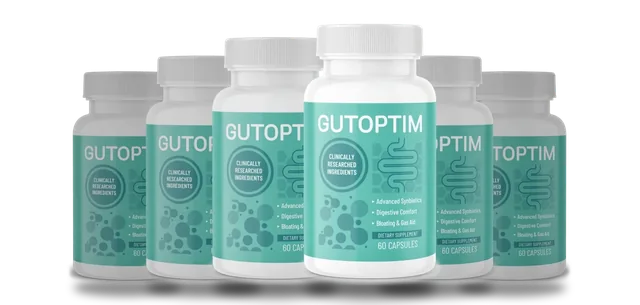
Order GutOptim on the official website
Psyllium husk first on the panel, oat bran and flaxseed behind it, 60 capsules a bottle. Free United States shipping and 60 days to change your mind.
Order GutOptimWhy the label asks for a full glass
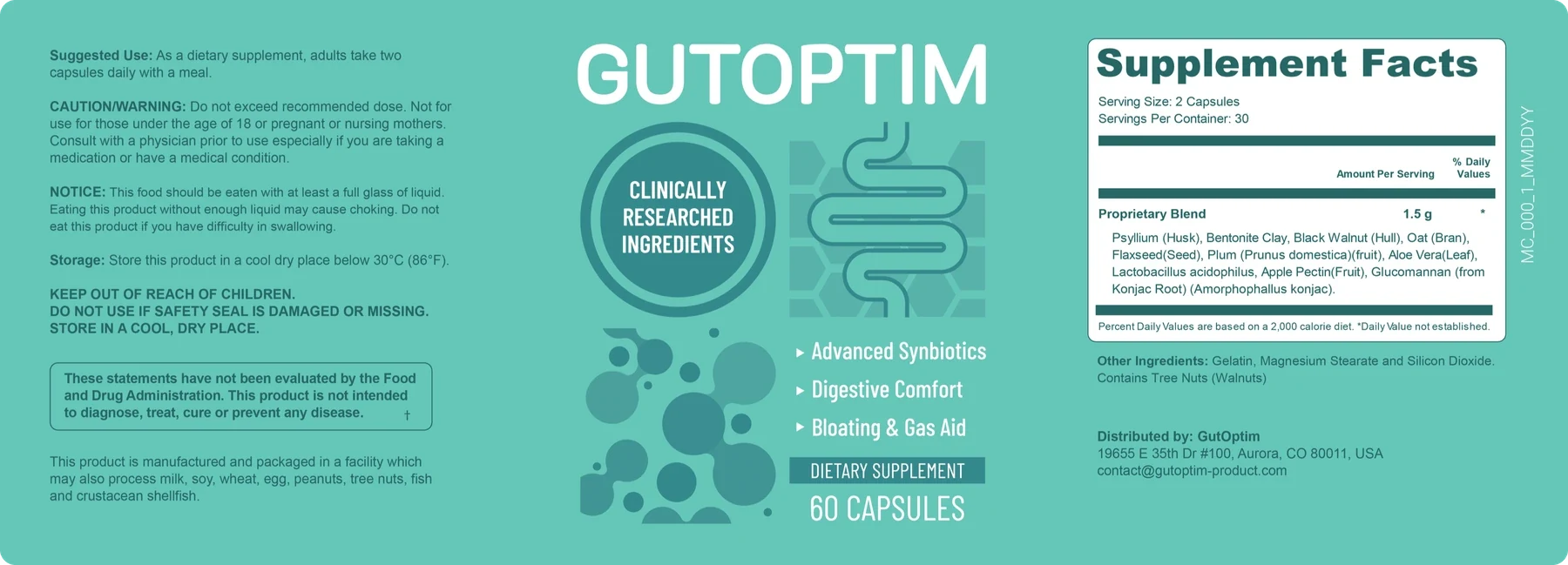
The label carries its own notice, and it is printed on the left of the panel where a photograph of the bottle front never shows it: “This food should be eaten with at least a full glass of liquid. Eating this product without enough liquid may cause choking. Do not eat this product if you have difficulty in swallowing.”
That wording is not decoration. A federal labelling rule covers water-soluble gums, hydrophilic gums and hydrophilic mucilloids, and its own section title names psyllium and glucomannan among them. The warning the rule requires reads: taking the product without adequate fluid may cause it to swell and block the throat or oesophagus and may cause choking, and it should not be taken by anyone who has difficulty swallowing. That rule governs over-the-counter drug labelling of those gums rather than dietary supplements, which sit in a different category, so it describes the ingredient rather than this bottle. The bottle then says the same thing in its own words.
Swallowing comes first. Take the capsules with at least a full glass of liquid, and do not take them at all if you have difficulty swallowing. If swallowing or breathing becomes difficult after a dose, that is a same-day conversation with a clinician rather than something to wait out.
What these fibres are not shown to do
The honest counterweight to everything above is a Cochrane review. Ruepert and colleagues pooled 12 trials of bulking agents in 621 patients with irritable bowel syndrome and found no benefit over placebo for abdominal pain, for global assessment or for symptom score. The soluble and the insoluble subgroups were both null. The review’s own conclusion is that there is no evidence bulking agents are effective for treating irritable bowel syndrome.
Constipation and irritable bowel syndrome are different questions with different answers, and the fibre story is not universal. A bottle of fibre is not a remedy for a diagnosed bowel condition, and nothing on this website presents it as one.
Comparing any fibre supplement with a trial
Everything above generalises, and it takes four questions rather than a degree. Ask them of any fibre product, this one included, and the marketing falls away quickly.
- Which kind of fibre is it? Gel-forming, soluble but non-viscous, or insoluble. The three behave differently and only the first is what most people picture when they read the word fibre.
- How many grams a day did the research use? Trial amounts in this field are published in grams, so any comparison has to be made in grams too.
- How long did the trials run? Four weeks was the floor in the constipation evidence, and a shorter trial is a different question with a different answer.
- What did they measure? A cholesterol result is not a bowel result, and a label that borrows one for the other is telling you something about itself.
Applied to this bottle the answers are: three gel-forming fibres among the ten names, research amounts in grams a day, trials of four weeks and longer, and two different outcomes measured in the two strongest bodies of evidence. None of that is hidden. It simply has to be read in the same units the research was written in.
Getting the fibre and the fluid right
Four practical things follow from the mechanism, and none of them costs anything.
- A full glass, every serving. The gel needs the water. This is the instruction on the bottle and it is the one people skip.
- With a meal. The label’s suggested use is two capsules daily with a meal, which also makes the habit easier to keep.
- Build up rather than jump. Adding a lot of fibre quickly is what produces the wind the trials recorded.
- Give it four weeks. The trials that found anything ran at least that long. The timing article covers the wait and which pack size covers it.
The how to take it page has the routine in full, and the ingredients page carries the evidence note for each of the six names the supplier gives.
Sources cited in this article
- McRorie JW Jr, McKeown NM. Understanding the Physics of Functional Fibers in the Gastrointestinal Tract: An Evidence-Based Approach to Resolving Enduring Misconceptions about Insoluble and Soluble Fiber. J Acad Nutr Diet. 2017;117(2):251-264. https://pubmed.ncbi.nlm.nih.gov/27863994/
- van der Schoot A, Drysdale C, Whelan K, Dimidi E. The Effect of Fiber Supplementation on Chronic Constipation in Adults: An Updated Systematic Review and Meta-Analysis of Randomized Controlled Trials. Am J Clin Nutr. 2022;116(4):953-969. https://pubmed.ncbi.nlm.nih.gov/35816465/
- Yu J, Xia J, Yang C, et al. Effects of Oat Beta-Glucan Intake on Lipid Profiles in Hypercholesterolemic Adults: A Systematic Review and Meta-Analysis of Randomized Controlled Trials. Nutrients. 2022;14(10). https://pubmed.ncbi.nlm.nih.gov/35631184/
- U.S. Code of Federal Regulations. 21 CFR 101.81 - Health claims: Soluble fiber from certain foods and risk of coronary heart disease (CHD). https://www.ecfr.gov/current/title-21/chapter-I/subchapter-B/part-101/subpart-E/section-101.81
- U.S. Code of Federal Regulations. 21 CFR 201.319 - Water-soluble gums, hydrophilic gums, and hydrophilic mucilloids ... as active ingredients; required warnings and directions. https://www.ecfr.gov/current/title-21/chapter-I/subchapter-C/part-201/subpart-G/section-201.319
- Ruepert L, Quartero AO, de Wit NJ, van der Heijden GJ, Rubin G, Muris JW. Bulking agents, antispasmodics and antidepressants for the treatment of irritable bowel syndrome. Cochrane Database Syst Rev. 2011;2011(8):CD003460. https://pubmed.ncbi.nlm.nih.gov/21833945/