GutOptim Official Website › Guides › Choosing A Gut Health Supplement
Choosing A Gut Health Supplement: An Eight-Point Checklist
Eight checks decide most of it: is every amount printed, is there a proprietary blend, is the allergen line clear, what is the capsule shell, is a live count given, who made it, how long is the guarantee, and what does the seller claim that the label does not. GutOptim passes four.
Eight checks for any gut health label
Written to be used on any bottle, including ones this desk does not sell. Each check is a question a panel can answer or cannot.
- Is every amount printed?
- Is there a proprietary blend?
- Is the allergen line clear?
- What is the capsule shell?
- Is a live bacterial count given?
- Is the maker named?
- How long is the guarantee?
- Does the seller claim more than the label?
All eight are answerable in a couple of minutes from two documents you already have: the Supplement Facts panel, and whatever page is selling you the bottle. They are in that order for a reason. The first two decide whether the rest of the panel can be checked at all, the middle four whether the product suits the person holding it, and the last two are about the seller rather than the bottle.
What a passing answer looks like on each of the eight
| Check | A passing answer | Why it matters |
|---|---|---|
| Is every amount printed? | A figure beside every name | The only way to set a product against a research intake |
| Is there a proprietary blend? | No blend, or the amounts printed anyway | A blend removes the split and nothing else |
| Is the allergen line clear? | The specific allergen named, facility line separate | Federal rules require the specific nut |
| What is the capsule shell? | Named on the Other Ingredients line | It decides whether the product suits a dietary restriction |
| Is a live bacterial count given? | Genus, species, strain and a count to end of shelf life | A species name is a family resemblance, not a dose |
| Is the maker named? | A company name and a physical address | It is who answers if a batch is wrong |
| How long is the guarantee? | Long enough to cover the evidence window | The trials here run four weeks and longer |
| Does the seller claim more than the label? | The sales page and the panel agree | One is labelling; the other is advertising |
Nothing in the middle column is expensive to print; few products do all of it at once.
Three rows lean on sources worth naming. The allergen row follows FDA labelling rules, which require the specific nut to be declared. The live-count row follows NCCIH, which states that different types of probiotics may have different effects. The first row leans on the plainest source of the lot: the NIH Office of Dietary Supplements describes a supplement as coming with a panel listing the active ingredients and the amount per serving — the normal case, not a favour.
The same eight, run against GutOptim
| Check | Answer | Detail |
|---|---|---|
| Is every amount printed? | No | One blend total, 1.5 g, covering ten names. |
| Is there a proprietary blend? | Yes | Which is what hides the amounts. |
| Is the allergen line clear? | Yes | “Contains Tree Nuts (Walnuts)”, printed plainly. |
| What is the capsule shell? | Stated | Gelatin, named on the Other Ingredients line. |
| Is a live bacterial count given? | No | L. acidophilus is named with no CFU. |
| Is the maker named? | Yes | GutOptim, 19655 E 35th Dr #100, Aurora, CO 80011, USA |
| How long is the guarantee? | 60 days | From purchase, return postage on the buyer. |
| Does the seller claim more than the label? | Yes | Several times, and the claims page lists them. |
Four of the eight are answered the way a buyer would want. The other four are the honest cost of a proprietary blend, and they are the same four almost every product in this category carries.
Four out of eight is a real score rather than a rhetorical one, and roughly where most of this aisle lands. Both halves are written out below — a scorecard with no reasoning under it is a graphic rather than an argument.
The four checks GutOptim does not pass
No amount is given for any single ingredient
The panel gives one figure, 1.5 g of Proprietary Blend per two-capsule serving, with the Daily Value column reading “Daily Value not established”. Ten names share it. To pass, the panel would need a figure beside each name, which is a printing decision rather than a reformulation.
There is a proprietary blend, and that is what removes the amounts
The blend is the mechanism rather than a separate fault, which is why the first two rows fail together on almost every label that fails either. What survives is a ceiling: ten names under 1.5 g means no one of them exceeds it.
The probiotic is named without a strain or a count
Lactobacillus acidophilus appears on the printed panel with no strain designation and no colony forming unit figure. Under the NCCIH position above, a species name alone cannot be matched to a published trial, so there is nothing to compare with another bottle.
The seller's page claims more than the printed label supports
This row is about the seller rather than the bottle, and it matters because the two documents are policed differently. The FDA describes the split: it is generally responsible for safety, quality and labeling while the FTC is responsible for advertising. Where the panel and the sales page disagree this desk follows the panel, and the side effects page prints the two claims that contradict it outright.
One further point belongs here rather than anywhere flattering. Where a mined mineral sits on a panel the published concern is contamination rather than efficacy — a survey of clays sold for oral use found lead as high as 99.7 mg/kg, which is a reason to ask any maker for batch testing.
The four checks GutOptim does pass, and what each is worth
The allergen line is specific
“Contains Tree Nuts (Walnuts)” is printed in bold under Other Ingredients, naming the nut rather than gesturing at a category, with the facility statement kept separate.
The capsule shell is named
The Other Ingredients line reads gelatin, magnesium stearate, silicon dioxide. Gelatin is an animal-derived shell, and a panel that says so lets a reader with a dietary restriction decide in one glance.
The maker is named with an address
GutOptim, 19655 E 35th Dr #100, Aurora, CO 80011, USA, printed on the panel. A small thing until a batch is wrong, at which point it is the difference between a company and a name.
The guarantee is stated in full
60 days from purchase, claimed by phone with the order ID, bottles posted back at the buyer’s cost. All three parts are published, which is more than the length alone.
What a proprietary blend can and cannot hide
A blend is the commonest reason a panel fails the first check, so it is worth knowing what it costs you.
What it hides: the split. How much of the total is the first name and how much is the last. That is the whole of it, and it is enough to make a dose comparison impossible.
What it cannot hide: the names, the serving size, the servings per container, the total itself, the allergen statement and the maker’s address. It cannot make a small total look large.
- Use the ceiling. Divide nothing and assume nothing — but every claim about any one ingredient has to fit under the total alongside all the others.
- Compare totals between bottles. Two blends of the same size with different name counts are different products.
- Check the total against a published intake. The federal health-claim doses are 3 grams a day of oat or barley beta-glucan and 7 grams a day of soluble fibre from psyllium seed husk, and the whole-diet fibre target is 22 to 34 grams a day. Any blend total can be read beside those without knowing the split.
- Ask. A maker may publish the split anyway, and whether it answers is information.
How to judge a guarantee, not just its length
A guarantee is the only line on a sales page that is a promise to you rather than a claim.
| Question | Why it matters | GutOptim |
|---|---|---|
| How long is the window? | The trials here run four weeks and longer, so a 30-day window closes too early | 60 days from the date of purchase |
| When does the clock start? | Purchase or delivery is a difference of one to three weeks | From purchase; dispatch is 5 to 7 working days in the US |
| Who pays the return postage? | The part most often left off a guarantee badge | The buyer, and tracking is the only proof of arrival |
| How is it claimed, and how long does the money take? | A phone-only route and a two-stage refund are both normal | By phone with the order ID; 3 to 5 business days to issue, then 5 to 10 days on the card |
The full terms are on the refund policy page. The point of the table is the four questions, which work on any bottle.
There is a fifth question the badge never answers: how much of the supply sits outside the window. A six-bottle order is 180 days of capsules against a 60-day guarantee, and the refund policy sets that out pack by pack.
Putting two labels side by side in ten minutes
- Convert both to a day. Two capsules once daily and one capsule twice daily are the same thing; two capsules twice daily is not.
- Find the amount column on each. If one panel has figures and the other has a blend total, that difference outweighs most of what the front of either bottle says.
- Count the names against the panel. A sales page and a panel do not always agree on how many ingredients there are.
- Read both allergen lines, then both facility lines. Only one of the two is about the recipe.
- Find both capsule shells. On the Other Ingredients line, in the smallest type on the bottle.
- Compare cost per day, not per bottle. Price per bottle flatters whichever product has the smaller serving.
- Run the four guarantee questions on each. Length, start, postage, and the route to a refund.
What this checklist leaves out, and why
Four things that look like evidence are missing from the eight on purpose, because each is weaker than it appears.
- Seals with no certificate behind them. A registered facility has filed paperwork: the FDA states that mere registration does not denote approval of the establishment or the product.
- The word natural. It has no regulatory definition for supplements, and a mined mineral clay is natural in the ordinary sense of the word rather than the sense most buyers read into it.
- Review counts and star averages. They describe a seller’s own channels and measure nothing about the capsule.
- “Clinically researched ingredients”. Researching an ingredient is not testing a product. The FTC standard for a health claim is competent and reliable scientific evidence for the claim being made, and the ceiling itself is set by the structure and function rule, whose worked example is that fibre maintains bowel regularity.
The ODS puts the general case in one sentence that belongs beside every panel here: many supplements need more study to determine if they have value. A checklist cannot fix that. It can tell you which bottle has given you enough to have the argument at all.
Sources cited in this guide
- NIH Office of Dietary Supplements. Dietary Supplements: What You Need to Know. https://ods.od.nih.gov/factsheets/WYNTK-Consumer/
- U.S. Food and Drug Administration. Questions and Answers on Dietary Supplements. https://www.fda.gov/food/information-consumers-using-dietary-supplements/questions-and-answers-dietary-supplements
- U.S. Food and Drug Administration. Is It Really 'FDA Approved'? https://www.fda.gov/consumers/consumer-updates/it-really-fda-approved
- U.S. Food and Drug Administration. Structure/Function Claims. https://www.fda.gov/food/nutrition-food-labeling-and-critical-foods/structurefunction-claims
- U.S. Food and Drug Administration. Food Allergies: What You Need to Know. https://www.fda.gov/food/buy-store-serve-safe-food/food-allergies-what-you-need-know
- National Center for Complementary and Integrative Health. Probiotics: Usefulness and Safety. https://www.nccih.nih.gov/health/probiotics-usefulness-and-safety
- U.S. Code of Federal Regulations. 21 CFR 101.81 - Health claims: Soluble fiber from certain foods and risk of coronary heart disease (CHD). https://www.ecfr.gov/current/title-21/chapter-I/subchapter-B/part-101/subpart-E/section-101.81
- National Institute of Diabetes and Digestive and Kidney Diseases. Eating, Diet, & Nutrition for Constipation. https://www.niddk.nih.gov/health-information/digestive-diseases/constipation/eating-diet-nutrition
- van der Schoot A, Drysdale C, Whelan K, Dimidi E. The Effect of Fiber Supplementation on Chronic Constipation in Adults: An Updated Systematic Review and Meta-Analysis of Randomized Controlled Trials. Am J Clin Nutr. 2022;116(4):953-969. https://pubmed.ncbi.nlm.nih.gov/35816465/
- Rao SSC, Brenner DM. Efficacy and Safety of Over-the-Counter Therapies for Chronic Constipation: An Updated Systematic Review. Am J Gastroenterol. 2021;116(6):1156-1181. https://pubmed.ncbi.nlm.nih.gov/33767108/
- Reeuwijk NM, Klerx WN, Kooijman M, Hoogenboom LA, Rietjens IM, Martena MJ. Levels of lead, arsenic, mercury and cadmium in clays for oral use on the Dutch market and estimation of associated risks. Food Addit Contam Part A Chem Anal Control Expo Risk Assess. 2013;30(9):1535-45. https://pubmed.ncbi.nlm.nih.gov/23862762/
- Federal Trade Commission. Health Products Compliance Guidance. https://www.ftc.gov/business-guidance/resources/health-products-compliance-guidance
- Federal Trade Commission, Consumer Advice. Common Health Scams. https://consumer.ftc.gov/articles/common-health-scams
About this guide
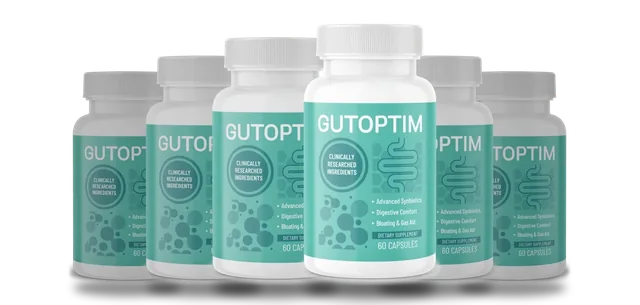
Order GutOptim on the official website
Four of eight, stated plainly, and 60 days to change your mind.
$49 to $69 a bottle · free US shipping · 60 days to change your mind
Order GutOptim On The Official WebsiteOne-time payment, no subscription · 60-day money-back guarantee · lot GUT-26/GE-5057