GutOptim Official Website › Blog › Probiotics
Is GutOptim a Probiotic? What the Synbiotic Label Means
GutOptim is described as a synbiotic, meaning a probiotic plus fibres. The printed panel lists Lactobacillus acidophilus alongside several fibres. But it gives no strain and no CFU count, and the supplier’s own list of six leaves the bacterium out. It is a capsule, not a gummy, powder or drops.
- The front of the bottle says Advanced Synbiotics.
- The printed panel lists Lactobacillus acidophilus. The supplier’s list of six does not.
- No strain and no CFU count is printed for the bacterium.
- Most of the other names on the panel are fibres.
- GutOptim comes as a capsule. No gummy, drops or powder version is listed.
- NCCIH states that different probiotics have different effects.
What does synbiotic mean on a GutOptim bottle?
A probiotic is a living bacterium sold to be swallowed. A prebiotic is a food for bacteria, often a fibre. A synbiotic joins the two in one product. The idea is simple: the bacterium arrives with a meal ready for it.
GutOptim’s front label says Advanced Synbiotics. On the printed panel, the bacterium is Lactobacillus acidophilus, and the fibres around it include psyllium, oat bran, flaxseed, apple pectin and glucomannan from konjac root. So the word fits what is on the bottle, in a loose sense.
The word describes a combination. It does not describe a result. A label may say a product is a synbiotic without saying how many bacteria it holds, which strain they are or whether they are still alive when the bottle is opened.
So is GutOptim a probiotic?
In part. The panel names a probiotic species, so the capsule holds one. But the supplier’s own list of six names does not include it. The seller’s list of nine does. The printed panel’s list of ten does.
| Source | Lists the bacterium? |
|---|---|
| Supplier’s pack (six names) | No |
| Seller’s sales page (nine names) | Yes, as L. Acidophilus |
| Printed Supplement Facts panel (ten names) | Yes, as Lactobacillus acidophilus |
This website states the supplier’s six, because the supplier’s pack governs what we say, and we show the panel’s ten so that you can see the bacterium on the label. The difference is real, and it is not explained in our sources.
So the honest wording is that GutOptim is mainly a fibre blend with a probiotic name on the panel. Most of what is listed takes up water or adds bulk. The bacterium is one name among ten, with no stated amount.
Why do the strain and the CFU count matter?
Because the strain is where the evidence lives. A species name is like saying a dog. It does not tell you the breed. Two strains of the same species can behave differently.
The National Center for Complementary and Integrative Health says plainly that different probiotics have different effects. So a result for one kind of Lactobacillus does not transfer to another. A good result you read about may belong to a strain that is not in this capsule.
A CFU count matters because it says how many live organisms were counted. A probiotic is usually sold on that figure, and it is normally given as the number at the end of shelf life. GutOptim prints none of this. The panel’s one amount is the 1.5 g blend, which covers all ten names together.
No study can be credited to GutOptim on the strength of the species name alone. That is a limit, not an accusation. If strain and count matter to you, they are the first questions for the maker.
Can a probiotic and a bulking fibre work at the same time?
There is an interesting wrinkle here, and it applies to any synbiotic. The two halves ask different things of fibre.
A fibre that feeds bacteria is one the bacteria can ferment. Fermentation is exactly what removes a fibre before it reaches the large bowel. A fibre that holds water in stool is one that survives fermentation and arrives intact. Some fibres do one job better than the other, and few do both at once.
A panel with several fibres could in theory cover both jobs. But a single blend total does not tell you which fibre carries which job. That is general fibre science from the research cited on this site. It is not a finding about this capsule.
The practical point is modest. When someone says a synbiotic does both, ask which ingredient and which amount does which. For GutOptim, the amounts are not published.
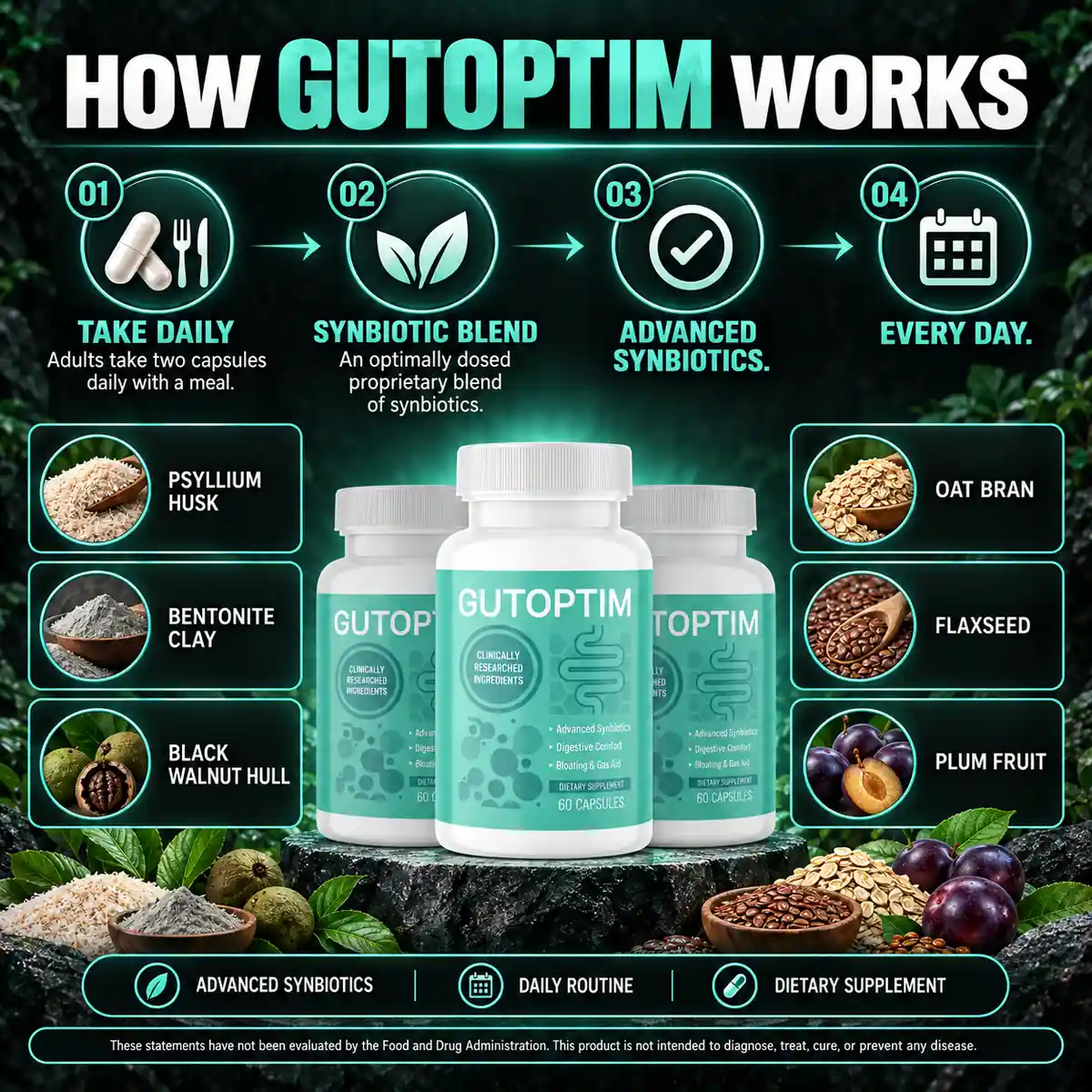
Is GutOptim a capsule, a pill, a gummy or drops?
It is a capsule. People search for gummies, drops, pills and powders, and the answers differ, so here is the plain list.
- Capsule: yes. The shell is gelatin.
- Gummy: no.
- Drops: no.
- Powder or drink: no. You swallow two capsules with a glass of liquid.
- Pill or tablet: the word is loose, but the product is a capsule, 60 to a bottle.
The label direction is the same however you think of it: as a dietary supplement, adults take two capsules daily with a meal. Take them with at least a full glass of liquid, because the fibre in the blend swells and the notice warns about choking.
Because the shell is gelatin, it is not vegetarian, even though the seller’s artwork carries a Vegetarian seal.
What should I ask before taking any probiotic product?
These questions work on any bottle in the category. They are also a short checklist for your doctor visit.
- Which species and which strain are printed?
- Is a live count given, and is it stated at the end of shelf life?
- Does the label say how to store it? GutOptim asks for a cool, dry spot under 30 degrees C (86 degrees F).
- Do you take a medicine or live with a health condition? If so, ask a doctor first. The GutOptim label asks the same.
- What are you expecting it to do, and when will you judge it? Buyers on record report four to eight weeks.
GutOptim is a dietary supplement and no drug. No FDA approval applies. Children under 18 and anyone pregnant or nursing should not take it. Ask your doctor about any medical question.
Frequently asked questions
Is GutOptim a probiotic?
It is described as a synbiotic. The panel lists Lactobacillus acidophilus alongside fibres, but the supplier’s list of six names does not include it, and no strain or live count is printed.
What is a synbiotic?
A synbiotic is a probiotic and the fibre that feeds it, sold together. On GutOptim’s panel that means Lactobacillus acidophilus with several fibres.
How many CFU are in GutOptim?
Not published. The panel prints a 1.5 g blend total for the whole capsule pair and no CFU count for the bacterium.
Do probiotic supplements work?
It depends on the strain and the reason for taking it. NCCIH states that different probiotics have different effects, so one product’s results cannot be assumed for another. No trial of GutOptim is published.
Is GutOptim a gummy or drops?
No. It is a capsule, 60 to a bottle, taken two at a time with a meal and a full glass of liquid.
Is GutOptim safe if I have a medical condition?
Ask your doctor first. The label wants a physician consulted by anyone on a medication or with a medical condition, and it leaves out anyone under 18, pregnant or nursing.
Our view
Our straight view is that the synbiotic label is better read as a description than as a promise. There is a bacterium on the panel, and there are fibres. What is missing is what a probiotic buyer usually wants: a strain, a count and some evidence for both.
That does not make the capsule worthless. It means the probiotic story is the least checkable part of it, and the fibre story is the better-understood part. If you are buying it for the bacterium, that is the gap to weigh.
This website is paid on orders, and we would rather you knew the gap than found it later. If probiotics matter to you for a medical reason, speak to a doctor before you start.
GutOptim is a dietary supplement. It is not a drug, and it is not FDA approved. No supplement is. These statements have not been evaluated by the Food and Drug Administration. This product is not intended to diagnose, treat, cure or prevent any disease. Talk to your doctor or pharmacist about any medical question.
Want to look at the label and the packs?
The order page shows the live price, free US shipping and the 60-day window before any payment details are asked for.
See today’s price and guaranteeThis website earns money on orders placed through it.
Sources cited in this article
- National Center for Complementary and Integrative Health. Probiotics: Usefulness and Safety. https://www.nccih.nih.gov/health/probiotics-usefulness-and-safety
- McRorie JW Jr, McKeown NM. Understanding the Physics of Functional Fibers in the Gastrointestinal Tract: An Evidence-Based Approach to Resolving Enduring Misconceptions about Insoluble and Soluble Fiber. J Acad Nutr Diet. 2017;117(2):251-264. https://pubmed.ncbi.nlm.nih.gov/27863994/
- van der Schoot A, Drysdale C, Whelan K, Dimidi E. The Effect of Fiber Supplementation on Chronic Constipation in Adults: An Updated Systematic Review and Meta-Analysis of Randomized Controlled Trials. Am J Clin Nutr. 2022;116(4):953-969. https://pubmed.ncbi.nlm.nih.gov/35816465/
- NIH Office of Dietary Supplements. Dietary Supplements: What You Need to Know. https://ods.od.nih.gov/factsheets/WYNTK-Consumer/
- U.S. Food and Drug Administration. Structure/Function Claims. https://www.fda.gov/food/nutrition-food-labeling-and-critical-foods/structurefunction-claims
Last updated