GutOptim Official Website › Blog › Labels
Six, Nine Or Ten: How Many Ingredients Are In GutOptim?
Three published lists give three counts. The supplier names six ingredients, the seller’s page prints a grid of nine, and the printed Supplement Facts panel lists ten, which is the other two lists added together. The grid of nine leaves out psyllium husk, the first name on the panel. This website states the six, because the supplier’s list governs.
- Six is the count stated here, and all six are printed on the bottle.
- Ten is what the Supplement Facts panel carries, and the extra four are real ingredients rather than a marketing flourish.
- Psyllium husk is first on the printed panel and missing from the grid of nine on the seller’s page.
- The panel gives one weight for the whole blend, 1.5 g a two-capsule serving, with the Daily Value not established.
Three lists, three counts, all of them real
Count the ingredients in this bottle and the answer depends on which document you count from. All three documents are real, all three are published, and they disagree by four names.
The supplier’s own list runs to six: psyllium husk, bentonite clay, black walnut hull, oat bran, flaxseed and plum fruit. The two listing panels in the product artwork photograph the same six and no others. The seller’s page prints a grid of nine, and its own opening line says ten while its frequently-asked questions say nine. The printed Supplement Facts panel, the one wrapped around the bottle you receive, lists ten.
| Where the list comes from | Names | What is on it |
|---|---|---|
| The supplier’s own list | Six | Psyllium husk, bentonite clay, black walnut hull, oat bran, flaxseed and plum fruit. |
| The seller’s page grid | Nine | Adds aloe vera, Lactobacillus acidophilus, apple pectin and konjac glucomannan, and leaves psyllium husk out. |
| The printed Supplement Facts panel | Ten | Both lists in one: the six, plus all four of the additions, inside a single 1.5 g blend. |
Panel read from the printed label on 18 September 2026. The seller’s figures were read from its own page on the same day.
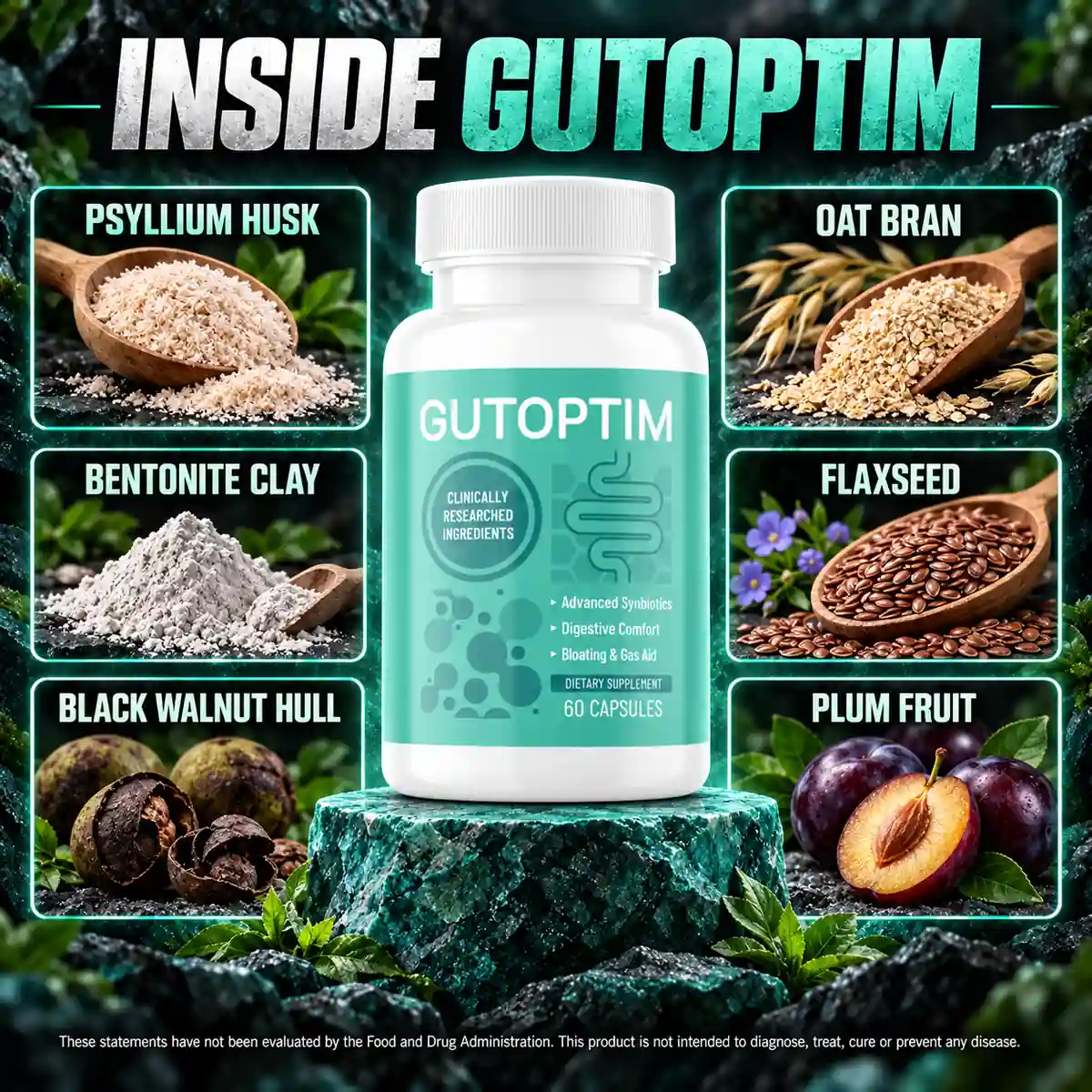
Ten is the union of the other two, so nothing here contradicts anything. Six of the ten are on every list. Four are on two lists out of three. One, psyllium husk, is on two lists and absent from the most public of the three.
The four names the seller’s grid adds
The four the grid adds are all printed on the panel, so they are in the capsule. Each is a different kind of ingredient, and the fourth is the one that changes what the bottle is.
- Aloe vera leaf. Aloe products are made from three different parts of the leaf, and the part matters more than the plant name. The ingredients page takes that apart.
- Lactobacillus acidophilus. A probiotic, and the only living thing on the list. It is named by species with no strain and no colony-forming unit count.
- Apple pectin. A soluble fibre from fruit, and one of only two fibres that came out with a significant effect in the constipation meta-analysis cited further down.
- Konjac glucomannan. A gel-forming fibre from konjac root, and the ingredient that puts this bottle in the same family as psyllium for swallowing. The fibre article covers what that means for the glass of liquid the label asks for.
The probiotic is the line worth slowing down on. NCCIH puts it plainly: different types of probiotics may have different effects, and if a particular kind of Lactobacillus helps with something, that does not mean another kind of Lactobacillus would do the same. A species name on its own does not identify what is in the capsule, and the front of the bottle calls the formula “Advanced Synbiotics”, a word that promises a probiotic and a fibre working together.
The one name the grid of nine leaves out
Psyllium husk is printed first in the blend on the Supplement Facts panel, and ingredients in a blend are listed in descending order of weight. It is also the ingredient on this panel with the deepest research record. It does not appear in the grid of nine, and it is the only one of the ten without an ingredient photograph on the seller’s page.
Why the printed panel is the list that counts
The two lists are governed by two different agencies under two different standards. The FDA sets out the split: the agency is generally responsible for the safety, quality and labelling of a supplement, and the Federal Trade Commission is generally responsible for its advertising. The Supplement Facts panel is labelling. A grid of ingredient tiles on a sales page is advertising.
That is also why a panel carries a fixed shape. The NIH Office of Dietary Supplements describes what a Supplement Facts label has to give you: the active ingredients, the amount per serving, and the other ingredients. The supplement facts page walks this bottle’s panel line by line.
One more thing follows from the same source. The agency does not approve a dietary supplement before it goes on sale, and it does not determine whether one works before it is marketed. So the panel is not a certificate. It is a disclosure, made by the manufacturer, in a format that is set for everyone.
Order GutOptim with the panel in view
Six names stated here, ten printed on the bottle, 60 capsules to a pack. Free United States shipping on all three packs and 60 days to change your mind.
Order GutOptimOne weight for ten names: the 1.5 g line
Everything on the panel sits inside one line: Proprietary Blend 1.5 g, daily value not established. A blend total is a real number and it does useful work. It is a ceiling. No single name inside the blend can weigh more than the blend weighs, so psyllium husk in one two-capsule serving is somewhere at or below 1.5 g, and so is everything else.
What the total cannot do is split itself. Ten names share one weight, in an order that tells you the ranking and not the gaps between the steps.
| What the panel prints | The figure on the bottle |
|---|---|
| Serving size | 2 capsules |
| Servings per container | 30 |
| Capsules per bottle | 60 |
| Proprietary Blend | 1.5 g per serving |
| Daily Value | Daily Value not established |
| Other ingredients | Gelatin, Magnesium stearate, Silicon dioxide |
| Allergen statement | Contains Tree Nuts (Walnuts) |
Read from the printed panel on 18 September 2026. Ingredients inside a blend are listed in descending order of weight, which is why the order of the ten names is itself information.
There is no rule capping a serving size either, and none setting how much of any dietary ingredient a serving may contain. That decision belongs to the manufacturer, which is why two capsules of one fibre supplement and two capsules of another are not comparable quantities at all.
What a count cannot tell you
The useful comparison is not between six and ten. It is between the serving on this label and the amounts the research used, and those are published for the two ingredients that have the strongest record.
A 2022 meta-analysis of 16 trials in 1,251 people found that fibre supplements beat control only at doses above 10 g a day, and only when they were taken for four weeks or more. Psyllium and pectin were the two fibres with a significant effect. The federal health-claim rule sets its qualifying intakes in the same territory: 7 g or more a day of soluble fibre from psyllium seed husk, or 3 g or more a day of beta-glucan soluble fibre from whole oats or barley.
Those are daily amounts, in grams, and a two-capsule serving is a fixed thing on the label. The how it works page sets the two side by side in full. What belongs here is the shape of the answer: the count tells you what is in the bottle, and the amounts tell you what it can be expected to do.
Reading an ingredient count in five minutes
Any supplement can be read this way, and it takes about as long as reading a bus timetable.
- Find the panel, not the page. The Supplement Facts panel is the list the manufacturer is answerable for. Photograph it when the bottle arrives.
- Count the names inside the blend line, then count the names on the sales page. If the two differ, the panel is the one to keep.
- Read the order. Names inside a blend run heaviest first, so the first two or three are most of what you are swallowing.
- Check the second list. Other ingredients is where the capsule shell and the flow agents live, and it is the line that decides whether a bottle suits a vegetarian.
- Find the allergen line. It is printed in bold under Other Ingredients, and on this bottle it is not optional reading.
- Compare a serving with a research amount, in the same unit, before deciding what a bottle is for.
What this website states, and why
Six is the formula stated across this website, because the supplier’s own list is the document this desk is accountable to and it names six. Ten is what the printed panel carries, and it is printed in full on the label page rather than being averaged with anything. Nine is the seller’s advertising, quoted where it is useful and adopted nowhere.
What none of the three numbers changes is the claims ceiling. The FDA’s own worked example of a permitted structure/function claim is “fiber maintains bowel regularity”, and such claims are not pre-approved by the agency. Ten names can support exactly what six can, which is why this website writes that fibre supports regularity and never that a capsule treats a condition.
None of that changes the bottle. Two capsules a day with a meal, 60 capsules to a bottle, 30 servings, and one blend weight on the panel. The ingredients page takes the six one at a time, and the pricing page puts a cost against a day of them.
Sources cited in this article
- U.S. Food and Drug Administration. Questions and Answers on Dietary Supplements. https://www.fda.gov/food/information-consumers-using-dietary-supplements/questions-and-answers-dietary-supplements
- NIH Office of Dietary Supplements. Dietary Supplements: What You Need to Know. https://ods.od.nih.gov/factsheets/WYNTK-Consumer/
- National Center for Complementary and Integrative Health. Probiotics: Usefulness and Safety. https://www.nccih.nih.gov/health/probiotics-usefulness-and-safety
- van der Schoot A, Drysdale C, Whelan K, Dimidi E. The Effect of Fiber Supplementation on Chronic Constipation in Adults: An Updated Systematic Review and Meta-Analysis of Randomized Controlled Trials. Am J Clin Nutr. 2022;116(4):953-969. https://pubmed.ncbi.nlm.nih.gov/35816465/
- U.S. Code of Federal Regulations. 21 CFR 101.81 - Health claims: Soluble fiber from certain foods and risk of coronary heart disease (CHD). https://www.ecfr.gov/current/title-21/chapter-I/subchapter-B/part-101/subpart-E/section-101.81
- U.S. Food and Drug Administration. Structure/Function Claims. https://www.fda.gov/food/nutrition-food-labeling-and-critical-foods/structurefunction-claims