GutOptim Official Website › Blog › Ingredients
Flaxseed On The GutOptim Label: Whole Seed, Ground Seed And What Gets Absorbed
The printed panel lists Flaxseed (Seed), fifth of ten names in a 1.5 g blend, and does not say whether the seed is whole or ground. Research says it matters: in trials, milled or ground flaxseed delivered ALA and lignans better than whole seed. The studies also used 5 to 50 g of flaxseed a day, against a ceiling of 1.5 g for the entire blend.
- The label says Seed and nothing about form, processing or amount, and this article quotes no GutOptim flaxseed amount.
- Whole seed gave 28 percent of the enterolignans that ground seed did in one crossover trial, and did not raise plasma ALA in another.
- Flaxseed bowel trials used 20 to 50 g a day. A pilot of whole against ground linseed found no clear difference.
- At the label ceiling, GutOptim could hold at most 3 to 30 percent of the flaxseed amounts those studies used.
- Three questions to ask the manufacturer are at the foot of the page.
What the panel prints for flaxseed
On the printed GutOptim Supplement Facts panel, flaxseed is the fifth of ten names inside the blend, and it is printed as Flaxseed (Seed). That is the whole entry. Around all ten names sits one line, Proprietary Blend, 1.5 g per serving, Daily Value not established, and there is no separate figure beside flaxseed. A serving is two capsules once a day with a meal.
The entry also leaves out three things a reader might reasonably want to know. It does not say whether the seed is whole or ground. It does not say whether it is milled, defatted or pressed. And it does not say what fraction of the blend it is. The parenthetical (Seed) tells you which part of the plant, and stops there.
That silence matters more for flaxseed than for most ingredients on the panel, because flaxseed is one of the few foods where the published research says the physical form changes what happens in the body. The rest of this article is about that research, and about what it can and cannot say about a seed sitting fifth in a 1.5 g blend. No flaxseed amount is quoted for GutOptim, because none is printed.
| Panel line | As printed | What is not stated |
|---|---|---|
| Name | Flaxseed (Seed) | Whole, ground, milled or otherwise processed |
| Position | Fifth of ten names | The gaps between one name and the next |
| Amount for this name | None printed | Any figure at all |
| Blend total | 1.5 g per serving, all ten names together | How the 1.5 g divides |
| Ceiling for flaxseed | No more than 1.5 g in a serving | Anything closer than that |
Read from the printed panel. Names inside a blend are listed heaviest first, so a fifth position suggests a smaller share than the first four, but it does not say how much smaller. The seller’s page calls the ingredient Flax Seeds.
What a flaxseed is made of, briefly
Flaxseed, called linseed in the United Kingdom, is a small oil-rich seed. The 1993 nutrition trial cited below describes the high-ALA variety it used as one of the richest dietary sources of alpha-linolenic acid, the plant omega-3 fat, and as a good source of soluble fibre mucilage. A 2005 crossover study opens with a sentence that gives the third ingredient of interest: flaxseed is one of the richest sources of lignans, plant compounds that gut bacteria convert into enterodiol and enterolactone.
So one seed carries a fat, a gel-forming mucilage, an insoluble fibre share and a lignan. Each of those has been measured in a different kind of study, and each depends on the seed being broken open. The label prints none of it. The timing article notes that flaxseed carries both soluble and insoluble fibre and is one of four fibres on the panel, which is the reason the glass of liquid is an instruction rather than advice.
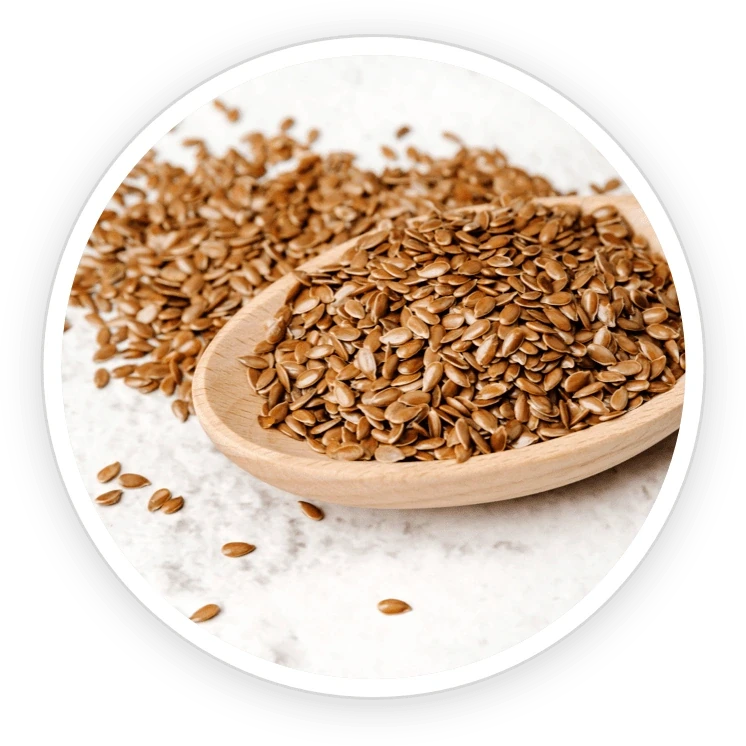
Whole seed against ground seed: three studies
Three published studies bear directly on whole versus ground flaxseed. None of them is about bowel habit, and that is worth remembering, but they answer the question the label leaves open: does the form change what gets absorbed?
Alpha-linolenic acid. Austria and colleagues, 2008, randomised healthy adults to 30 g of whole flaxseed, 30 g of milled flaxseed, or flaxseed oil providing 6 g of ALA, each baked into muffins and eaten for three months. After one month, plasma ALA had risen significantly in the oil group and in the milled-seed group, and the oil group was higher. The whole-seed group did not achieve a significant rise. Nobody’s EPA or DHA went up, and cholesterol, triglycerides and platelet aggregation did not change in any group. Everyone reported some digestive discomfort early on. It disappeared in the oil and milled groups, whereas whole seed and oil caused adverse effects within four weeks severe enough that some people withdrew, and compliance was a problem in the whole-seed group. The authors’ conclusion is that milled flaxseed may be a good form to avoid serious side effects while still raising ALA.
Lignans. Kuijsten and colleagues, 2005, gave twelve healthy people 0.3 g of flaxseed per kilogram of body weight a day, as whole, crushed or ground seed, in a randomised crossover with 10 days on each form and 11-day washouts between. Plasma enterolignans were measured. Compared with ground seed, whole seed delivered 28 percent of the enterolignans and crushed seed 43 percent. The title of the paper says it plainly: bioavailability of enterolignans is enhanced by milling and crushing. For a 70 kg adult, 0.3 g per kilogram is 21 g of seed a day, which is a useful figure to keep in mind for the arithmetic below.
Ground seed in bulk. Cunnane and colleagues, 1993, fed healthy women 50 g a day of ground raw flaxseed for four weeks. Their plasma and red-cell ALA rose, urinary thiocyanate rose 2.2-fold, total cholesterol fell 9 percent and LDL cholesterol 18 percent. When 12 g of ALA a day came from 50 g of raw flaxseed flour or from 20 g of flaxseed oil, the rise in plasma ALA was equivalent, which the authors read as high bioavailability of ALA from ground flaxseed. Test meals containing 25 g of flaxseed mucilage cut the blood-sugar rise after eating by 27 percent, and the authors concluded that up to 50 g a day was palatable and safe in that group.
These three do not contradict one another. They agree that a seed which has been ground or milled gives up more of what is inside it than a whole seed does. Whole seed, in these studies, did less at the level of absorption and caused more trouble at the level of tolerance.
What the bowel trials used, and what they measured
Flaxseed is often bought for regularity, and there are trials that say something about it. All of them use amounts that are easy to picture on a plate rather than in a capsule.
- 50 g of flaxseed flour a day. Sun and colleagues, 2020, randomised 90 adults with Rome IV functional constipation to 50 g of flaxseed flour with meals or 15 mL of lactulose solution for four weeks. Bowel habits improved in both. The median Wexner constipation score fell from 14 to 6.5 on flaxseed and from 15 to 9 on lactulose, and median weekly defecation frequency rose from 2 to 7 on flaxseed and from 2 to 6 on lactulose. The comparison was against another treatment rather than a placebo, and group sizes were unequal at 60 and 30.
- 20 g a day, baked into cookies. Soltanian and Janghorbani, 2018, gave 53 constipated people with type 2 diabetes 10 g of flaxseed in cookies twice a day, or placebo cookies, for 12 weeks. Constipation symptom scores, weight, fasting glucose and cholesterol all improved more on flaxseed than on placebo. Their follow-up trial in 77 patients used the same 10 g twice daily of flaxseed or psyllium against placebo cookies. Both beat placebo, and the authors found flaxseed appeared superior. Both trials were single-blinded and both were in people with diabetes.
- Two tablespoons of linseed a day, whole or ground. Cockerell and colleagues, 2012, ran a pilot in 40 people with irritable bowel syndrome. Two tablespoons of whole linseed, two of ground linseed or none, for four weeks. Only 31 people finished. Neither seed group differed significantly from control on symptom severity, whole and ground did not differ from each other, and there were no significant changes in stool frequency or consistency in any group. The authors say linseeds may be useful and that more research is needed to tell whole from ground.
The honest summary is that flaxseed at tens of grams a day has moved constipation scores in constipation trials in Iran and China, that the trials were not large and not always blinded, and that a small pilot in a different condition showed no clear difference between whole and ground. There is no trial here of flaxseed at a gram or two.
Cholesterol, and the word whole
Pan and colleagues, 2009, pooled 28 studies of flaxseed and its derivatives on blood lipids. Across all interventions, total cholesterol fell by 0.10 mmol/L and LDL by 0.08 mmol/L, with intervals that reached zero. The split is more interesting. Whole flaxseed lowered them by 0.21 and 0.16 mmol/L and lignan supplements by 0.28 and 0.16 mmol/L, whereas flaxseed oil did not. HDL and triglycerides did not change. The effect was more apparent in women, particularly after the menopause, in people with high starting cholesterol, and in the better-designed studies.
A word of caution about the word whole in that abstract. It separates seed as a food from oil and from lignan extracts, and the abstract does not say how each trial prepared the seed. This article does not read it as evidence that unmilled seed beats milled seed, and it would be a mistake to set it against the ALA study above. They measured different things in different people.
Lignans have their own dose-response study. Hutchins and colleagues, 2000, gave 31 postmenopausal women 0, 5 or 10 g of ground flaxseed a day for seven weeks each. Compared with no flaxseed, 5 g and 10 g raised urinary enterolactone by about 21,000 and about 53,000 nmol a day. The excretion of these gut-derived compounds rose in step with the dose. That result is a biomarker of intake, a sign that the lignans were absorbed and processed, and not an outcome anyone can feel.
The arithmetic against a 1.5 g ceiling
Here are the amounts these studies used, set against the one figure the panel prints. The right-hand column is a best case in which every gram of the blend is flaxseed, and that is impossible, since nine other names share it.
| Study | What it measured | Daily flaxseed | 1.5 g ceiling as a share of it |
|---|---|---|---|
| Hutchins 2000, lowest dose | Urinary lignans | 5 g ground | At most 30 percent |
| Hutchins 2000, higher dose | Urinary lignans | 10 g ground | At most 15 percent |
| Soltanian 2018 | Constipation, weight, lipids | 20 g in cookies | At most 7.5 percent |
| Austria 2008 | Plasma ALA | 30 g whole or milled | At most 5 percent |
| Cunnane 1993 | ALA, cholesterol | 50 g ground | At most 3 percent |
| Sun 2020 | Constipation scores | 50 g flour | At most 3 percent |
| Kuijsten 2005 | Enterolignans | 0.3 g per kg, about 21 g at 70 kg | At most about 7 percent |
Arithmetic on two figures only: the daily amount each study reports and the 1.5 g blend total on the label. The real flaxseed share is smaller than every figure in the last column, by an amount the label does not disclose.
Even the most generous reading leaves the panel at less than a third of the smallest dose in the table, and at a few percent of the doses in the bowel trials. On the same logic the ALA is easy to bound. Cunnane’s 50 g of flour supplied 12 g of ALA, which is 0.24 g per gram of that particular high-ALA seed. At the same ratio, 1.5 g of flour would carry at most about 0.36 g of ALA, and that is before nine other ingredients get their share. The ALA figures in those studies were 6 g a day as oil and 12 g a day as oil or flour.
One trial did use a small amount of linseed. Sairanen and colleagues, 2007, gave 43 elderly people with mild constipation a yoghurt containing 12 g of galacto-oligosaccharides, 12 g of prunes and 6 g of linseed a day, for three weeks in a crossover, and defecation frequency was higher than on control yoghurt, 8.0 against 7.1 times a week. It was a combined product, the effect cannot be divided between its three ingredients, and its sponsorship line names Valio Ltd, R&D. Still, 6 g is four times the blend ceiling.

Order GutOptim on the official website
Ten names in one 1.5 g blend, 60 capsules a bottle, two a day with a meal and a full glass of liquid. Free United States shipping and 60 days to change your mind.
Order GutOptimWhat a fibre-and-mucilage seed in a small blend can and cannot be expected to do
Being fair to the ingredient means saying what it can do as well as what it cannot.
It can be part of a fibre supply. A seed with soluble mucilage and insoluble fibre is a genuine fibre ingredient, and it sits alongside three other fibres on the panel. Whatever it contributes, it contributes to the same total as the psyllium, oat bran, glucomannan and pectin. That is a reasonable thing for a fibre capsule to include.
It cannot reproduce a trial. None of the studies above tested anything like a gram or so. The ALA and lignan results are about grams to tens of grams of seed, in a state where the seed had been ground, and the bowel results are about 20 to 50 g. There is no dose-response study that lets anyone extrapolate downwards to a fraction of a 1.5 g share, and this article does not pretend to draw one.
It cannot be judged by its form, because the form is not disclosed. A capsule holding a powder blend makes milled seed the more natural guess, but it is a guess. The word flaxseed covers whole seed, milled seed and other preparations, and the research shows that they differ. The people best placed to say which is in the bottle are the manufacturer, and a question about it is fair.
It cannot be a stand-in for the seed on a plate. A tablespoon of ground flaxseed in porridge has a fibre, fat and lignan content that a capsule’s share of a blend does not. If the point of buying is the omega-3, the lignans or the amount of fibre the trials used, the food is where the research comes from.
Practical notes from the label and the trials
- A full glass, every time. The label says to take the capsules with at least a full glass of liquid, that eating the product without enough liquid may cause choking, and not to take it if swallowing is difficult. The gel-forming fibres on the panel, flaxseed’s mucilage among them, are the reason for it. The glucomannan article covers the swelling risk in more detail.
- Expect an adjustment period. In the ALA study, digestive discomfort appeared in all groups in the early weeks, and the trials that found anything ran four weeks or more. The timing article covers the wait.
- Medicines. Fibre can change how some medicines are absorbed, so the gap between a capsule and a prescription is worth a question to a pharmacist.
- The label’s own cautions. Not for anyone under 18, pregnant or nursing, and a physician first if you take medication or have a medical condition.
Three questions worth sending to the manufacturer
- Is the flaxseed whole, milled or ground, and has any of the oil been removed? The research says the form changes absorption, and the panel does not say.
- How many milligrams of it are in a two-capsule serving? A blend total protects a recipe, but a single figure for one ingredient answers a fair question and costs the recipe very little.
- Is the seed the whole of the ingredient, or a fraction such as the hull? The panel says Seed, and the studies used seed.
Until those are answered, the accurate description of flaxseed in GutOptim is short. It is a named ingredient, fifth of ten, in an undisclosed form and amount, inside a blend that caps every ingredient at 1.5 g. The research on flaxseed is real and much of it is encouraging, and all of it was done at amounts many times larger than that ceiling. You can write to the website desk with the questions above, and the ingredients page lists all ten names with a note on the evidence for each. The plum article makes the same comparison for the panel’s fruit ingredient.
Sources cited in this article
- Austria JA, Richard MN, Chahine MN, Edel AL, Malcolmson LJ, Dupasquier CM, et al. Bioavailability of alpha-linolenic acid in subjects after ingestion of three different forms of flaxseed. J Am Coll Nutr. 2008;27(2):214-21. https://pubmed.ncbi.nlm.nih.gov/18689552/
- Kuijsten A, Arts IC, van’t Veer P, Hollman PC. The relative bioavailability of enterolignans in humans is enhanced by milling and crushing of flaxseed. J Nutr. 2005;135(12):2812-6. https://pubmed.ncbi.nlm.nih.gov/16317125/
- Cunnane SC, Ganguli S, Menard C, Liede AC, Hamadeh MJ, Chen ZY, et al. High alpha-linolenic acid flaxseed (Linum usitatissimum): some nutritional properties in humans. Br J Nutr. 1993;69(2):443-53. https://pubmed.ncbi.nlm.nih.gov/8098222/
- Cockerell KM, Watkins AS, Reeves LB, Goddard L, Lomer MC. Effects of linseeds on the symptoms of irritable bowel syndrome: a pilot randomised controlled trial. J Hum Nutr Diet. 2012;25(5):435-43. https://pubmed.ncbi.nlm.nih.gov/22690855/
- Soltanian N, Janghorbani M. Effect of flaxseed or psyllium vs. placebo on management of constipation, weight, glycemia, and lipids: A randomized trial in constipated patients with type 2 diabetes. Clin Nutr ESPEN. 2019;29:41-48. https://pubmed.ncbi.nlm.nih.gov/30661699/
- Soltanian N, Janghorbani M. A randomized trial of the effects of flaxseed to manage constipation, weight, glycemia, and lipids in constipated patients with type 2 diabetes. Nutr Metab (Lond). 2018;15:36. https://pubmed.ncbi.nlm.nih.gov/29760761/
- Sun J, Bai H, Ma J, Zhang R, Xie H, Zhang Y, et al. Effects of flaxseed supplementation on functional constipation and quality of life in a Chinese population: A randomized trial. Asia Pac J Clin Nutr. 2020;29(1):61-67. https://pubmed.ncbi.nlm.nih.gov/32229443/
- Pan A, Yu D, Demark-Wahnefried W, Franco OH, Lin X. Meta-analysis of the effects of flaxseed interventions on blood lipids. Am J Clin Nutr. 2009;90(2):288-97. https://pubmed.ncbi.nlm.nih.gov/19515737/
- Hutchins AM, Martini MC, Olson BA, Thomas W, Slavin JL. Flaxseed influences urinary lignan excretion in a dose-dependent manner in postmenopausal women. Cancer Epidemiol Biomarkers Prev. 2000;9(10):1113-8. https://pubmed.ncbi.nlm.nih.gov/11045796/
- Sairanen U, Piirainen L, Nevala R, Korpela R. Yoghurt containing galacto-oligosaccharides, prunes and linseed reduces the severity of mild constipation in elderly subjects. Eur J Clin Nutr. 2007;61(12):1423-8. https://pubmed.ncbi.nlm.nih.gov/17299467/