GutOptim Official Website › Blog › Ingredients
Plum On The GutOptim Label Versus The Prune Trials: Reading The Gap
The panel prints Plum (Prunus domestica) (fruit), sixth of ten names in a 1.5 g blend, with no form and no amount. The verified prune trials used 80 to 120 g of whole dried fruit a day, so the entire blend is at most about 1.5 percent of the trial doses. A result about a bowl of prunes cannot be carried across to a capsule ingredient of unstated form.
- The label says fruit and gives no form, fresh, dried, powder or extract, and no amount.
- Attaluri 2011 gave 100 g of dried plums a day for three weeks against psyllium, in 40 mostly female adults with constipation.
- Later trials used 80 to 120 g of prunes, and a pooled analysis found no difference between prunes and psyllium.
- At the label ceiling, the whole GutOptim blend is 1.25 to 1.9 percent of those doses.
- Six reasons the comparison cannot be transferred are set out, with questions for the manufacturer.
What the panel prints for plum
The printed GutOptim panel lists the sixth name in the blend as Plum (Prunus domestica) (fruit). That is a species and a plant part and nothing else. It does not say whether the plum is fresh, dried, powdered or an extract. It does not say how much there is. Around all ten names sits a single line, Proprietary Blend, 1.5 g per serving, Daily Value not established, and a serving is two capsules once a day with a meal.
The plum is a fair place to look closely, because it is the one ingredient on the panel with a well-known food behind it. Prunes are dried plums, and nearly everyone has heard that they help you go. The ingredients page of this website says as much, noting one good trial of whole dried fruit at 100 g a day. This article walks through that trial and the ones around it, and then explains why a result about a bowl of prunes cannot be carried across to a capsule ingredient whose form is unstated.
| Panel line | As printed | What is not stated |
|---|---|---|
| Name | Plum (Prunus domestica) (fruit) | Fresh, dried, powder or extract |
| Position | Sixth of ten names | How far it sits below the names before it |
| Amount for this name | None printed | Any figure at all |
| Blend total | 1.5 g per serving, all ten names together | How the 1.5 g divides |
| Ceiling for plum | No more than 1.5 g in a serving | Anything closer than that |
Read from the printed panel. Names inside a blend are listed heaviest first, so sixth place suggests a smaller share than the first five, but it does not say how much smaller. The seller’s page shows the ingredient photograph under the name Prune.

The verified trial: prunes against psyllium
The trial most often cited for prunes and constipation is Attaluri and colleagues, 2011, in Alimentary Pharmacology and Therapeutics. Here is what it did, from its own abstract.
- Who. Forty adults with chronic constipation, three men and thirty-seven women, mean age 38.
- Design. An 8-week, single-blind, randomised crossover. Each person took dried plums for 3 weeks and psyllium for 3 weeks, with a 1-week washout between.
- Doses. Dried plums at 50 g twice a day, giving 6 g of fibre a day. Psyllium at 11 g twice a day, also stated as 6 g of fibre a day. That is 100 g of fruit against 22 g of psyllium a day.
- Endpoints. The primary outcome was complete spontaneous bowel movements a week. Others were global relief of constipation, stool consistency, straining, tolerability and taste.
- Findings. Complete spontaneous bowel movements and stool consistency improved significantly with dried plums compared with psyllium. Straining and global symptom relief did not differ. Both were rated equally palatable, and both were safe and well tolerated.
The authors concluded that dried plums were safe, palatable and more effective than psyllium for mild to moderate constipation, and should be considered a first-line therapy. That conclusion is worth reading with the design in front of it. The comparison was with psyllium, not with placebo, so it cannot say how much of the improvement any real treatment would have shown. It was single-blind and only 40 people, almost all women, over three weeks. It measured one condition, constipation, in people who had it.
The 2014 systematic review of prunes and gastrointestinal function puts numbers on it. In constipation, three weeks of 100 g a day of prunes gave 3.5 complete spontaneous bowel movements a week against 2.8 on psyllium at 22 g a day, and a stool consistency score of 3.2 against 2.8 on the Bristol scale. Only four randomised trials met the review’s criteria at all, one in constipation and three in people who were not constipated. It found no differences in digestive symptoms between prunes and comparators, judged two of the trials to have an unclear risk of bias, and called for more rigorous research.
What the trials since found
A second constipation trial, 100 g again. Chey and colleagues, 2021, partially randomised 79 adults with chronic constipation to two green kiwifruit a day, 100 g of prunes a day or 12 g of psyllium a day for four weeks. The primary endpoint, the proportion whose complete spontaneous bowel movements rose by at least one a week, was similar across the three. All three treatments raised weekly bowel movements, prunes and kiwifruit improved stool consistency, and all three improved straining. Adverse events were most common with psyllium and fewest with kiwifruit. The trial was exploratory and only partially randomised, and 87 percent of the participants were women.
A healthy-adult trial at 80 g and 120 g. Lever and colleagues, 2019, randomised 120 healthy adults with low fibre intakes and infrequent stools, three to six a week, to 80 g of prunes a day, 120 g of prunes a day or control, each with 300 mL of water, for four weeks. Stool weight, measured by a seven-day collection, was the primary outcome. It rose by 22.2 g a day on 80 g of prunes and 32.8 g a day on 120 g, against a fall of 0.8 g a day on control. Stool frequency was higher on both prune doses, whole-gut transit time did not change, and flatulence was significantly more common after prunes. The confidence interval around the 80 g result included zero, which is worth knowing when reading the headline.
The pooled view. A 2024 systematic review and meta-analysis of foods, drinks and diets in chronic constipation pooled 23 studies and 1,714 participants. Fruit as a group produced more bowel movements a week than psyllium, driven mainly by kiwifruit. For prunes specifically, two studies, there was no difference compared with psyllium. The authors call the evidence scarce and ask for more trials.
That last point fits the trial above without cancelling it. Attaluri found prunes better than psyllium on two endpoints in one small crossover. The pooled analysis, which counted two prune studies, finds no difference for prunes against psyllium. Both are true of the data available, and neither is a claim about any capsule.
The arithmetic against a 1.5 g ceiling
Every prune trial above is described in grams of fruit a day. The panel is described in grams of blend a day. Setting them next to each other takes one line of division. The right-hand column is a best case in which every gram of the blend is plum, which is impossible because nine other names share it.
| Study | Population and length | Daily plum | 1.5 g ceiling as a share of it |
|---|---|---|---|
| Attaluri 2011 | Constipated adults, 3 weeks | 100 g dried plums, as 50 g twice a day | At most 1.5 percent |
| Chey 2021 | Constipated adults, 4 weeks | 100 g of prunes | At most 1.5 percent |
| Lever 2019, lower arm | Healthy low-fibre adults, 4 weeks | 80 g of prunes | At most 1.9 percent |
| Lever 2019, higher arm | Healthy low-fibre adults, 4 weeks | 120 g of prunes | At most 1.25 percent |
| Sairanen 2007, combined yoghurt | Elderly, mild constipation, 3 weeks | 12 g of prunes, plus linseed and GOS | At most 12.5 percent |
Arithmetic on two figures only: the daily amount each abstract reports and the 1.5 g blend total on the label. The real plum share is smaller than every figure in the last column, by an amount the label does not disclose.
The one row with a small amount, Sairanen’s, was a yoghurt containing 12 g of galacto-oligosaccharides, 12 g of prunes and 6 g of linseed a day, given to 43 elderly people with mild constipation for three weeks in a crossover. Defecation frequency was higher than on control yoghurt, 8.0 against 7.1 a week, and the sponsorship line names Valio Ltd, R&D. Because it was a three-ingredient product no one can say what the prunes contributed. Even so, 12 g is eight times the entire blend, before the other nine names take their share.
Fibre makes the same point from another side. Attaluri’s 100 g of dried plums supplied 6 g of fibre a day by the abstract’s own count. The whole GutOptim blend, all ten names, fibres and clay and bacteria and leaf included, is capped at 1.5 g.
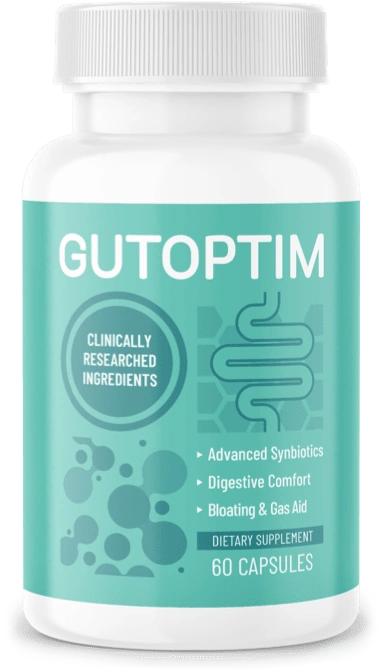
Order GutOptim on the official website
Ten names in one 1.5 g blend, 60 capsules a bottle, two a day with a meal and a full glass of liquid. Free United States shipping and 60 days to change your mind.
Order GutOptimWhy the prune result cannot be transferred to a capsule
The dose gap is the loudest reason, and it is not the only one. Each of the following would matter even if the doses were closer.
- Amount. The trials used tens of grams of fruit. The label caps the plum at a share of 1.5 g. At the ceiling that is a gap of about 67 times for a 100 g trial dose, and it is larger if plum is a small fraction of the blend, as its sixth position suggests.
- Form. Every prune trial fed whole dried fruit. A dried plum, a plum powder, a juice and an extract are different materials. A 2013 review of dried plums and their products covers the fruit, prune juice and dried plum powder separately, and lists sorbitol, quinic acid, chlorogenic acids, vitamin K1, boron, copper and potassium among the constituents of interest. Which of those, or which combination, does the work in a bowl of prunes is not settled, and which of them survives into a capsule ingredient is a question about the maker’s process, not about the fruit.
- What a concentrate showed. The nearest thing to an extract trial in the results is a 2017 study of prune essence concentrate. Its abstract names Prunus domestica Linn, the same species name the panel prints. Sixty healthy people with mildly raised cholesterol drank 50 mL or 100 mL of the concentrate or 50 mL of a simulated drink for four weeks. Counts of bifidobacteria and lactobacilli rose, counts of two other bacteria fell, and total and LDL cholesterol fell by roughly 6 to 7 percent. Notice what its abstract reports: gut bacterial counts and blood lipids after a small volume of liquid, and no stool frequency. It is not a bowel-habit result, and it is not a capsule either.
- Fluid. The healthy-adult trial gave every arm, control included, 300 mL of water a day, so its result is about prunes plus a set amount of fluid. The label has its own fluid instruction for the capsules, at least a full glass, and it is a safety instruction rather than part of any trial.
- Population and length. Mostly women with constipation in two trials, healthy low-fibre adults in another, for three or four weeks of daily dosing. The label is for healthy adults over 18, and its suggested use names no duration.
- Endpoint. Complete spontaneous bowel movements, Bristol stool form and stool weight are measured outcomes. The panel prints no claim, so there is nothing on the bottle for the trials to support, and this article does not supply one.
Nothing on that list says plum is a poor ingredient. Plum is a fruit with a long record as a food, and as an ingredient it may add something that has not been measured. That is the fair reading: unmeasured, not disproven. What the research cannot do is lend the size of a bowl of prunes to something the size of a fraction of 1.5 g.
What plum might reasonably contribute
A fruit ingredient in a fibre blend could plausibly add a little fibre, a little sorbitol and some plant chemistry to whatever else is there. Whether it does, and how much, depends on the form and the quantity, and those are exactly the two things the panel does not print. This article will not guess at them, because the whole point of a blend total is that outsiders cannot check.
The trials make one thing clear about the fruit itself. Where prunes did something measurable, the consistent features were the food, the tens of grams, the daily habit and the weeks. Flatulence was recorded as more common after prunes in the healthy-adult trial, so an adjustment period is normal. If what interests you is the prune evidence, the prune is the ingredient the trials used, and it is sold as a food.
That is not an argument against the capsule. The ingredient count article explains why the printed panel is the document to read, and the same panel is the reason to keep expectations tied to what it says. A blend like this is a fibre and botanical formula with a total weight, and its ingredients can be named and admired without being credited with a trial they were not in.
Questions worth sending to the manufacturer
- What form of plum is in the capsule? Whole dried fruit, a powder, a juice concentrate and an extract are not interchangeable in the research.
- How many milligrams per two-capsule serving? One figure for one ingredient answers the whole question of scale.
- Is the plum dried whole, or is it a fraction of the fruit? The panel says fruit, and the trials used the whole fruit.
You can send those to the website desk. In the meantime, the accurate summary is short. Plum is the sixth name in the blend, in an undisclosed form and amount, and the published prune trials used about 67 times the entire blend ceiling in whole dried fruit. That is a comparison of two very different quantities, and the honest thing to do with it is set the trials aside and read the panel.
The same comparison for the panel’s seed and its konjac fibre is in the flaxseed article and the glucomannan article. Before you judge any fibre capsule, the timing article covers the weeks it takes and the gap to leave around medicines, and the ingredients page lists all ten names with a note on the evidence for each.
Sources cited in this article
- Attaluri A, Donahoe R, Valestin J, Brown K, Rao SS. Randomised clinical trial: dried plums (prunes) vs. psyllium for constipation. Aliment Pharmacol Ther. 2011;33(7):822-8. https://pubmed.ncbi.nlm.nih.gov/21323688/
- Lever E, Cole J, Scott SM, Emery PW, Whelan K. Systematic review: the effect of prunes on gastrointestinal function. Aliment Pharmacol Ther. 2014;40(7):750-8. https://pubmed.ncbi.nlm.nih.gov/25109788/
- Chey SW, Chey WD, Jackson K, Eswaran S. Exploratory Comparative Effectiveness Trial of Green Kiwifruit, Psyllium, or Prunes in US Patients With Chronic Constipation. Am J Gastroenterol. 2021;116(6):1304-1312. https://pubmed.ncbi.nlm.nih.gov/34074830/
- Lever E, Scott SM, Louis P, Emery PW, Whelan K. The effect of prunes on stool output, gut transit time and gastrointestinal microbiota: A randomised controlled trial. Clin Nutr. 2019;38(1):165-173. https://pubmed.ncbi.nlm.nih.gov/29398337/
- Van Der Schoot A, Katsirma Z, Whelan K, Dimidi E. Systematic review and meta-analysis: Foods, drinks and diets and their effect on chronic constipation in adults. Aliment Pharmacol Ther. 2024;59(2):157-174. https://pubmed.ncbi.nlm.nih.gov/37905980/
- Sairanen U, Piirainen L, Nevala R, Korpela R. Yoghurt containing galacto-oligosaccharides, prunes and linseed reduces the severity of mild constipation in elderly subjects. Eur J Clin Nutr. 2007;61(12):1423-8. https://pubmed.ncbi.nlm.nih.gov/17299467/
- Stacewicz-Sapuntzakis M. Dried plums and their products: composition and health effects--an updated review. Crit Rev Food Sci Nutr. 2013;53(12):1277-302. https://pubmed.ncbi.nlm.nih.gov/24090144/
- Chiu HF, Huang YC, Lu YY, Han YC, Shen YC, Golovinskaia O, et al. Regulatory/modulatory effect of prune essence concentrate on intestinal function and blood lipids. Pharm Biol. 2017;55(1):974-979. https://pubmed.ncbi.nlm.nih.gov/28164731/