GutOptim Official Website › Blog › Evidence
Glucomannan In GutOptim: What Konjac Trials Dosed Against A 1.5 g Ceiling
Glucomannan is the tenth and last name in the GutOptim blend, and the label prints no amount for it. The konjac trials that moved bowel measures in adults used about 3 to 4.5 g a day, in three doses, so the whole 1.5 g blend, all ten names together, is at most a third to a half of those amounts. The same swelling in water is why the label asks for at least a full glass of liquid.
- Glucomannan is printed last of ten names, and the 1.5 g total is a ceiling for every name, not a figure for this one.
- The adult konjac bowel trials used 3 g to 4.5 g a day, split into three doses. A GutOptim serving is one dose of two capsules.
- The biggest pooled konjac results are about cholesterol and weight, and the bowel trials are small and short.
- Swelling is the reason for the full-glass notice, and oesophageal obstruction with a glucomannan product is in the case literature.
- Nothing here is a claim about what GutOptim does. No GutOptim glucomannan amount is printed, so none is quoted.
Where glucomannan sits on the GutOptim panel
Read the printed Supplement Facts panel from the top and you get a serving of two capsules, thirty servings a container, and one line that matters more than the rest: Proprietary Blend, 1.5 g per serving, Daily Value not established. Inside that line are ten names in a fixed order. The last of them reads Glucomannan (from Konjac Root). Nine other names come before it, and there is no separate amount printed beside any of them.
Two things follow from that layout, and neither needs a guess. The first is that 1.5 g is a ceiling. No single name can weigh more than the blend it belongs to, so glucomannan in one serving is somewhere at or below 1.5 g, and so is every other ingredient. The second is that names inside a blend are listed heaviest first, a rule the ingredient count article sets out in full. Being tenth of ten is therefore a position that points towards a smaller share rather than a larger one. What the order cannot tell you is how much smaller. Ten names can step down gently or fall away sharply, and the bottle does not say which.
That is exactly where this article stops estimating. It does not put a number on the glucomannan in a GutOptim capsule, because nobody outside the manufacturer has one. What it can do is set the one number that is printed, the 1.5 g ceiling, beside the amounts that published konjac trials actually used.
| Panel line | As printed on the bottle |
|---|---|
| Name | Glucomannan (from Konjac Root) |
| Position in the blend | Tenth of ten, the last name printed |
| Amount for this name | None printed |
| Amount for the whole blend | 1.5 g per serving, Daily Value not established |
| Serving | 2 capsules once a day with a meal, 30 servings a bottle |
| What it caps | Glucomannan can be no more than 1.5 g in a serving |
Transcribed from the printed panel. The homepage text names only six ingredients and glucomannan is not among them, but the supplement facts page prints all ten, and the panel is the document the manufacturer answers for.
What konjac glucomannan is, in one paragraph
Glucomannan is the main polysaccharide from the tuber of the konjac plant, Amorphophallus konjac. A clinical case report cited further down describes it as a dietary fibre with very substantial water-holding properties, one that forms highly viscous solutions and expands rapidly to many times the size of the original material. That single property explains the rest of this article. It is why glucomannan has been studied for bowel habit, cholesterol and appetite, and it is also why the bottle carries a notice about liquid and choking.

Glucomannan is one of three gel-forming fibres on this panel, along with psyllium and the beta-glucan in oat bran. How a gel-forming fibre behaves in the gut, and why some fibres are fermented while others are not, is covered in the psyllium and oat beta-glucan article, and it is not repeated here. This article is about one question only: what dose did the konjac evidence come from?
The adult bowel trials, one at a time
The published trials of glucomannan for bowel habit in adults are few and small. Here are the ones whose abstracts state what was given and what was measured.
Healthy adults, 4.5 g a day. Chen and colleagues, 2006, studied eight healthy adults eating a controlled low-fibre Chinese diet. Everyone went through a 21-day placebo period, a 7-day adaptation period in which konjac glucomannan was introduced progressively, and then a 21-day period on 1.5 g with each meal, or 4.5 g a day. Compared with the placebo period, defecation frequency rose by about 27 percent, wet stool weight by about 30 percent and dry stool weight by about 22 percent. Faecal lactobacilli and total bacteria rose too. What the trial did not do is compare two groups. It compared the same eight people with themselves, in a fixed order, and the participants were not constipated.
Constipated adults, 4.5 g a day. The same group then repeated the design in seven constipated people: 21 days of placebo, 7 days of adaptation, 21 days at 1.5 g three times a day. Weekly defecation frequency went from 4.1 to 5.3, which the authors describe as a slight but significant improvement in bowel movement. Faecal wet weight and moisture did not change significantly. The authors called this a modest dose and reported a 30 percent increase in bowel movement. Seven people is a very small trial, and it was not a comparison between a konjac group and a placebo group running side by side.
Transit time, 3 g a day. Marzio and colleagues, 1989, measured something different again. They gave 13 patients with chronic idiopathic constipation either glucomannan at 1 g three times a day or a placebo, double-blind, for 10 days, and measured mouth-to-cecum transit time with a lactulose breath-hydrogen test. Transit was slower in the constipated group than in 18 matched controls, and it returned to the normal range after glucomannan but not after placebo. That is a finding about how fast material moves through the upper gut. It is not a finding about how many times anyone went to the toilet, and ten days is very short.
Athletes, eight weeks. The most recent trial in the set is a 2025 double-blind randomised trial in elite male taekwondo athletes with functional constipation, who took konjac glucomannan or a placebo for eight weeks. The konjac group improved on the constipation symptom score, the quality-of-life score, bowel movement frequency and the bowel function index compared with placebo, and their gut microbiota shifted. The abstract does not state the dose, and the participants were all male elite athletes, so the result is a useful signal rather than a portrait of the average adult.
Put together, these four trials suggest that glucomannan at a few grams a day, taken as a course, has moved bowel measures in small groups. They do not suggest anything about a fraction of a gram, because none of them tested one.
What the children’s trials add, and why they matter here
The GutOptim label is not for anyone under 18, so children are not the audience. The children’s trials still belong in the picture, because they are placebo-controlled trials of glucomannan for constipation, and because they disagree with each other.
Loening-Baucke and colleagues, 2004, ran a double-blind crossover in children with chronic functional constipation. Glucomannan and placebo were each given at 100 mg per kilogram of body weight a day, up to a maximum of 5 g, with 50 mL of fluid for every 500 mg, for four weeks each. Of 46 children recruited, 31 finished. Success on the physician’s rating was 45 percent on fibre and 13 percent on placebo, and fewer children complained of abdominal pain on fibre.
Chmielewska and colleagues, 2011, then randomised 80 children aged 3 to 16 to 2.52 g a day of glucomannan or placebo for four weeks. Treatment success, defined as three or more stools a week with no soiling, was similar in both groups, with a relative risk of 0.95. Abdominal pain episodes were more frequent in the glucomannan group at week 1 and at week 4. The paper’s own title says glucomannan was not effective.
A 2017 meta-analysis of three trials in 122 children pooled three randomised trials. Glucomannan increased defecation frequency by 1.40 stools a week, with a 95 percent confidence interval of 0.36 to 2.44, but made no significant difference to stool consistency or to the rate of successful treatment. The authors asked for a cautious reading because of the small sample.
The lesson is not that glucomannan works or fails in children. It is that a fibre trial is a statement about a group, a dose, a duration and an outcome, and changing any one of the four can change the verdict.
Cholesterol and weight: the larger bodies of evidence
Most of the glucomannan literature is not about bowels at all. It is about cholesterol, glucose and body weight, and those are the outcomes with meta-analyses behind them.
- LDL cholesterol. Ho and colleagues, 2017, pooled 12 randomised trials with 370 participants, 8 in adults and 4 in children, each following people for at least three weeks. Konjac glucomannan lowered LDL cholesterol by 0.35 mmol/L and non-HDL cholesterol by 0.32 mmol/L, with no effect on apolipoprotein B. The authors describe their findings as supporting an intake of about 3 g of konjac glucomannan a day.
- A wider set of markers. Sood and colleagues, 2008, pooled 14 studies with 531 participants. Glucomannan lowered total cholesterol by about 19 mg/dL, LDL by about 16 mg/dL, triglycerides by about 11 mg/dL, body weight by 0.79 kg and fasting glucose by about 7 mg/dL. It did not change HDL cholesterol or blood pressure, and children, people on dietary modification and people with impaired glucose metabolism benefited less.
- Weight. Onakpoya and colleagues, 2014, looked only at overweight and obese participants. Eight trials pooled to a difference of −0.22 kg, with an interval of −0.62 to +0.19, which is not statistically significant. Their conclusion is that the trials do not show glucomannan causes significant weight loss. Adverse events in those trials included abdominal discomfort, diarrhoea and constipation.
Two reviews of weight, two answers that differ in size and in whether the interval clears zero. That is normal for a field of small trials. The label prints no claim about cholesterol or weight, and neither does this article. They are here because anyone who searches for konjac will meet these numbers, and they should be read with the dose attached.
The arithmetic against a 1.5 g ceiling
Here are the published doses in one place, set against the only figure the panel gives. The last column asks a narrow question: if every gram of the blend were glucomannan, which it cannot be, how much of the trial dose would that be?
| Study | Daily glucomannan | Given as | 1.5 g ceiling as a share of it |
|---|---|---|---|
| Chen 2006, healthy adults, 21 days | 4.5 g | 1.5 g with each meal | At most a third |
| Chen 2008, constipated adults, 21 days | 4.5 g | 1.5 g three times a day | At most a third |
| Marzio 1989, constipated adults, 10 days | 3 g | 1 g three times a day | At most a half |
| Ho 2017, cholesterol meta-analysis | About 3 g | Not stated in the abstract | At most a half |
| Chmielewska 2011, children, 4 weeks | 2.52 g | Not stated in the abstract | At most about 60 percent |
| Loening-Baucke 2004, children, 4 weeks | Up to 5 g | 100 mg/kg, with fluid | At most 30 percent |
Arithmetic on two figures only, the daily amount each abstract reports and the 1.5 g blend total printed on the label. The ceiling is for the whole blend, so the real glucomannan share is smaller than every figure in the last column, by an amount the label does not disclose.
Read the last column as a best case, then remember that it is impossible. Nine other names share the 1.5 g with glucomannan, among them psyllium, bentonite clay, black walnut hull, oat bran, flaxseed, plum, aloe, Lactobacillus acidophilus and apple pectin. Whatever glucomannan gets, it gets less than the whole.
Two further mismatches sit behind the grams, and they matter as much as the number does.
- Splitting. The three adult bowel trials with a stated schedule divided the day’s glucomannan into three doses, with meals or three times daily. A GutOptim serving is a single dose of two capsules once a day.
- Isolation. Those trials tested glucomannan by itself, over 10 days to 8 weeks, against a placebo or a placebo period. No trial in this article tested a ten-name blend, and the GutOptim site itself says the product has not been the subject of a published clinical trial.
None of this says the capsules do nothing, and none of it says they work. It says the konjac evidence is about konjac at grams a day, and that the bottle is a different object with a much smaller and undisclosed share of it. Someone who wants to know whether a fibre blend suits them can still find out the ordinary way, by taking it as directed and noting what changes. The timing article explains why that takes weeks rather than days.
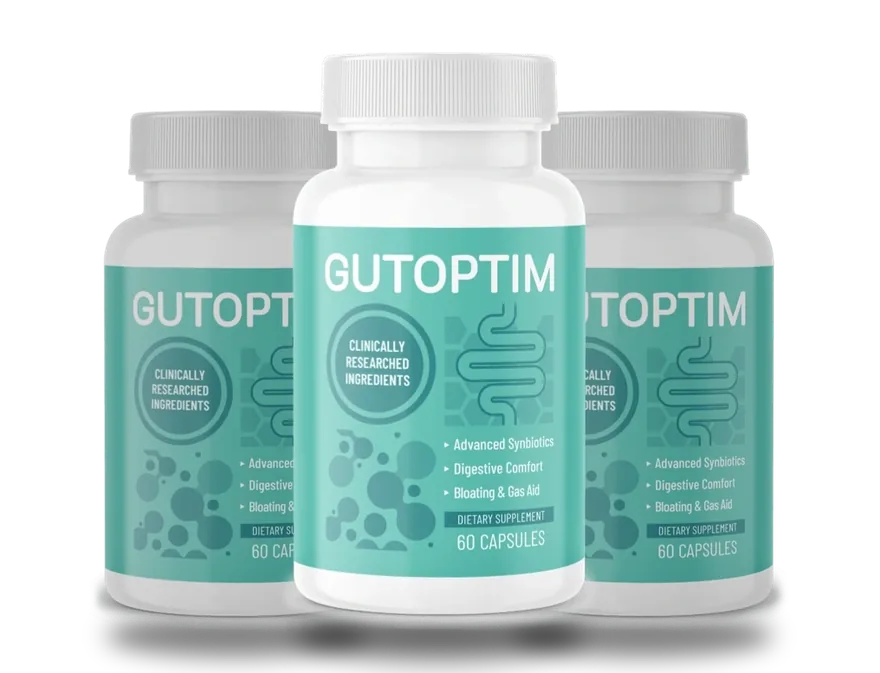
Order GutOptim on the official website
Ten names in one 1.5 g blend, 60 capsules a bottle, two a day with a meal and a full glass of liquid. Free United States shipping and 60 days to change your mind.
Order GutOptimSwelling, choking and the full-glass notice
The printed notice on the GutOptim label reads: “This food should be eaten with at least a full glass of liquid. Eating this product without enough liquid may cause choking. Do not eat this product if you have difficulty in swallowing.” Glucomannan is the ingredient on the panel that most obviously earns it, because of what it does in water.
A 2007 case report in Clinical Toxicology describes a 37-year-old woman who developed delayed oesophageal obstruction after taking an over-the-counter diet aid containing glucomannan. She cleared the obstruction through forceful vomiting just before an upper gastrointestinal endoscopy, and an oesophageal web was found on outpatient endoscopy afterwards. The authors list flatulence, abdominal pain, gastrointestinal obstruction and possible changes in the absorption of other medicines among the negative effects reported for glucomannan, and they write that the case illustrates the potential dangers of glucomannan and other hygroscopic medications in people with a history of upper gastrointestinal disease.
It is not the only such item in the literature. A 1986 piece in the British Medical Journal carries the title “Glucomannan and risk of oesophageal obstruction”. PubMed lists it without an abstract, so all this article will say about it is that the risk was raised in print four decades ago. A case report cannot tell anyone how common a problem is. What it can do is show that the mechanism is real, and the mechanism is the same one that makes the fibre work.
The trials handled it in their own way. In the children’s crossover trial above, every dose was given with fluid at a fixed ratio of 50 mL for each 500 mg. That is a research protocol, not a rule for adults, and the label’s instruction, at least a full glass of liquid, is the one to follow. There is also a federal labelling rule, 21 CFR 201.319, which requires a swelling and choking warning on over-the-counter drug products containing gums such as glucomannan. It governs drug labelling rather than supplements, so it describes the ingredient and not this bottle, but the wording is close to the wording on the bottle. The psyllium article describes it, and the rule itself is on the eCFR.
In plain terms:
- Take the capsules with at least a full glass of liquid, every serving, and do not take them dry.
- If you have difficulty swallowing, a known narrowing of the gullet or a history of upper digestive problems, do not start without asking a physician. The label says the same, and the case report above is why.
- If swallowing becomes difficult or painful after a dose, or something feels stuck in the chest or throat, treat it as a same-day medical question. If breathing is affected, call emergency services.
- If you take regular medication, read the timing article and ask your pharmacist about spacing, since fibre can change how some medicines are absorbed.
Five questions for any glucomannan claim
The same questions work for any product that borrows konjac research, this one included.
- What was measured? Stool frequency, transit time, LDL cholesterol and body weight are four different outcomes with four different bodies of evidence.
- How many grams a day? Konjac results in this article come from about 2.5 to 5 g a day. A label that prints no amount cannot be checked against them.
- In how many doses? The bowel trials split the day into three. A once-a-day serving is a different pattern.
- For how long, and in whom? Ten days to eight weeks, in healthy adults, constipated adults, athletes and children. Those are not interchangeable.
- With how much fluid? A gel-forming fibre without water is a safety question, not just an efficacy question.
Answering them for GutOptim gives a short and honest result. Glucomannan is on the printed panel. Its amount is not printed. The most it could be is 1.5 g, and being last of ten, it is very likely a fraction of that. The trials on which the ingredient’s reputation rests used roughly 2.5 to 5 g a day, on its own, in divided doses, against a ceiling of 1.5 g for all ten names together. The bottle asks for a full glass of liquid for a reason with a published case history behind it.
What this leaves is a modest claim, and it is the only one the evidence supports. GutOptim contains a konjac fibre, alongside nine other names, in an undisclosed share of a 1.5 g blend. If you want to know what a konjac dose looks like, the trials describe it in grams. If you want to know what is in the bottle, the manufacturer is the only source, and it is a fair question to send to the website desk. The ingredients page lists all ten names with a note on the evidence for each, and the safety page covers what fibre does in the first fortnight.
Sources cited in this article
- Chen HL, Cheng HC, Liu YJ, Liu SY, Wu WT. Konjac acts as a natural laxative by increasing stool bulk and improving colonic ecology in healthy adults. Nutrition. 2006;22(11-12):1112-9. https://pubmed.ncbi.nlm.nih.gov/17027233/
- Chen HL, Cheng HC, Wu WT, Liu YJ, Liu SY. Supplementation of konjac glucomannan into a low-fiber Chinese diet promoted bowel movement and improved colonic ecology in constipated adults: a placebo-controlled, diet-controlled trial. J Am Coll Nutr. 2008;27(1):102-8. https://pubmed.ncbi.nlm.nih.gov/18460488/
- Marzio L, Del Bianco R, Donne MD, Pieramico O, Cuccurullo F. Mouth-to-cecum transit time in patients affected by chronic constipation: effect of glucomannan. Am J Gastroenterol. 1989;84(8):888-91. https://pubmed.ncbi.nlm.nih.gov/2547312/
- Zhu Y, Chen X, Song G. Effects of konjac glucomannan on gastrointestinal symptoms and gut microbiota in athletes with functional constipation: a double-blind randomized controlled trial. Eur J Nutr. 2025;64(8):303. https://pubmed.ncbi.nlm.nih.gov/41117955/
- Loening-Baucke V, Miele E, Staiano A. Fiber (glucomannan) is beneficial in the treatment of childhood constipation. Pediatrics. 2004;113(3 Pt 1):e259-64. https://pubmed.ncbi.nlm.nih.gov/14993586/
- Chmielewska A, Horvath A, Dziechciarz P, Szajewska H. Glucomannan is not effective for the treatment of functional constipation in children: a double-blind, placebo-controlled, randomized trial. Clin Nutr. 2011;30(4):462-8. https://pubmed.ncbi.nlm.nih.gov/21320737/
- Han Y, Zhang L, Liu XQ, Zhao ZJ, Lv LX. Effect of glucomannan on functional constipation in children: a systematic review and meta-analysis of randomised controlled trials. Asia Pac J Clin Nutr. 2017;26(3):471-477. https://pubmed.ncbi.nlm.nih.gov/28429913/
- Ho HVT, Jovanovski E, Zurbau A, Blanco Mejia S, Sievenpiper JL, Au-Yeung F, et al. A systematic review and meta-analysis of randomized controlled trials of the effect of konjac glucomannan, a viscous soluble fiber, on LDL cholesterol and the new lipid targets non-HDL cholesterol and apolipoprotein B. Am J Clin Nutr. 2017;105(5):1239-1247. https://pubmed.ncbi.nlm.nih.gov/28356275/
- Sood N, Baker WL, Coleman CI. Effect of glucomannan on plasma lipid and glucose concentrations, body weight, and blood pressure: systematic review and meta-analysis. Am J Clin Nutr. 2008;88(4):1167-75. https://pubmed.ncbi.nlm.nih.gov/18842808/
- Onakpoya I, Posadzki P, Ernst E. The efficacy of glucomannan supplementation in overweight and obesity: a systematic review and meta-analysis of randomized clinical trials. J Am Coll Nutr. 2014;33(1):70-8. https://pubmed.ncbi.nlm.nih.gov/24533610/
- Vanderbeek PB, Fasano C, O’Malley G, Hornstein J. Esophageal obstruction from a hygroscopic pharmacobezoar containing glucomannan. Clin Toxicol (Phila). 2007;45(1):80-2. https://pubmed.ncbi.nlm.nih.gov/17357389/
- Henry DA, Mitchell AS, Aylward J, Fung MT, McEwen J, Rohan A. Glucomannan and risk of oesophageal obstruction. Br Med J (Clin Res Ed). 1986;292(6520):591-2. https://pubmed.ncbi.nlm.nih.gov/3004635/
- U.S. Code of Federal Regulations. 21 CFR 201.319 - Water-soluble gums, hydrophilic gums, and hydrophilic mucilloids ... as active ingredients; required warnings and directions. https://www.ecfr.gov/current/title-21/chapter-I/subchapter-C/part-201/subpart-G/section-201.319