GutOptim Official Website › Blog › Ingredients
What Is Inside a GutOptim Capsule? A Plain-English Ingredient Glossary
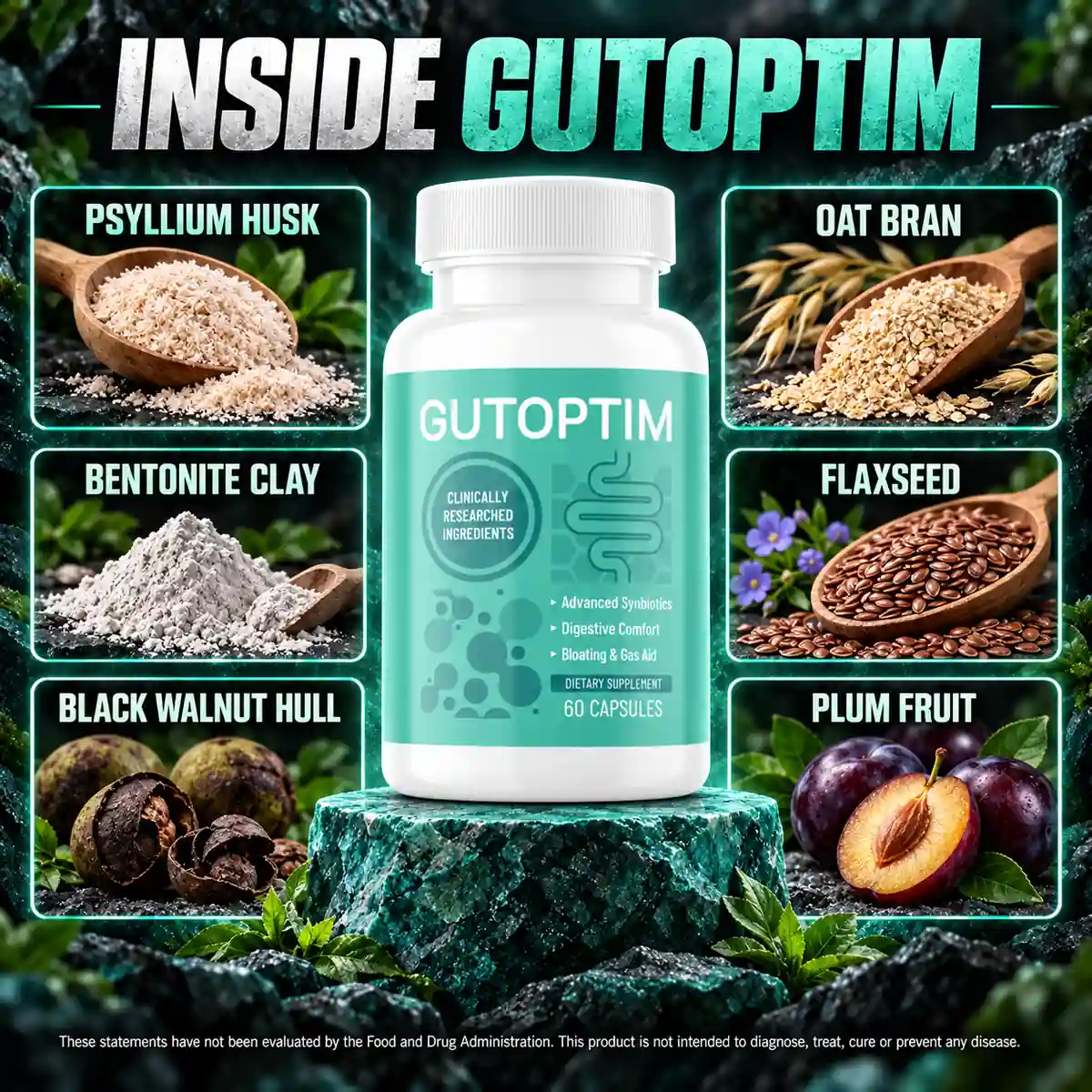
A GutOptim capsule holds a single proprietary blend of 1.5 g per two capsules, covering ten printed names: psyllium, bentonite clay, black walnut hull, oat bran, flaxseed, plum, aloe vera, Lactobacillus acidophilus, apple pectin and konjac glucomannan. The shell is gelatin. The amount of each name is not published.
- The panel lists ten names in one blend of 1.5 g per serving of two capsules. The Daily Value is not established.
- The supplier names six of the ten. The seller’s page prints a different list of nine.
- Other ingredients: gelatin, magnesium stearate and silicon dioxide.
- The shell is gelatin, which is an animal product, so the capsule is not vegetarian.
- Allergens: Contains Tree Nuts (Walnuts). The plant may also handle milk, soy, wheat, egg, peanuts, tree nuts, fish and crustacean shellfish.
- No amount is printed for any single ingredient, and no CFU count for the bacterium.
What is in the GutOptim blend, name by name?
Think of the capsule as one pile of powder with ten labels on it. The panel does not split the pile. It gives a single figure, 1.5 g of proprietary blend per serving, and lists the ten names in a row. The order of the names is the only clue to size, and even that is not a promise.
| Name on the panel | What it is, in plain words | Named by the supplier |
|---|---|---|
| Psyllium (Husk) | The husk of a seed. It is a soluble fibre that takes up water and forms a gel. | Yes |
| Bentonite Clay | A mineral clay, not a plant and not a bacterium. | Yes |
| Black Walnut (Hull) | The green outer covering of a walnut. It is why the label carries a tree nut line. | Yes |
| Oat (Bran) | The outer layer of the oat grain. It carries beta-glucan, a soluble fibre. | Yes |
| Flaxseed (Seed) | Linseed, a mix of soluble and insoluble fibre with a little oil. | Yes |
| Plum (Prunus domestica) (fruit) | The fruit behind the dried plum, also called a prune. | Yes |
| Aloe Vera (Leaf) | A succulent plant. The panel says leaf. | No |
| Lactobacillus acidophilus | A named bacterium. No strain and no count of live organisms is printed. | No |
| Apple Pectin (Fruit) | A fibre taken from fruit. | No |
| Glucomannan (from Konjac Root) | A fibre from the konjac plant that swells strongly in water. | No |
Notice the right-hand column. The supplier’s pack names six. The panel lists ten. This website states the supplier’s six, because the pack governs what we say, and shows the rest so you can see what the bottle itself prints.
Which names are fibres, and why does that matter?
Most of the list is fibre. Psyllium, oat bran, flaxseed, apple pectin and glucomannan are all fibres of one kind or another, and plum is a fruit eaten partly for its fibre. That is the reason the label asks for a full glass of liquid.
Not every fibre acts the same. A review in the Journal of the Academy of Nutrition and Dietetics makes the point that viscosity, not the word soluble, decides how a fibre behaves in the gut. Fibres that form a thick gel and resist being eaten by gut bacteria are the ones that hold water in the stool.
That is general science about fibre. It is not a result for this capsule. Since the panel does not print how much of each fibre is inside, no one can say which of them is doing the work, or whether a given fibre is present in a useful amount.
What is the bentonite clay doing in there?
Bentonite is a mined clay. The seller builds a good deal of the product’s story around it, but the label simply lists it second, with no amount.
There is no published trial of bentonite clay for digestive outcomes in people. The work on swallowed clays mostly measures what the clays contain. A 2013 survey of clays for oral use on the Dutch market measured heavy metals in 63 products and estimated the risks. It tested other products on another market, so it says nothing about this lot.
It is a good reason to ask for paperwork. This website has not read a laboratory report for lot GUT-26/GE-5057, because none is published, and we say so. For more on the clay, see our post on bentonite clay in a gut supplement.
What about black walnut hull, aloe and the bacterium?
Black walnut hull is the one ingredient with no usable record of human trials for digestive outcomes in the sources we cite. It is also the reason the panel prints Contains Tree Nuts (Walnuts). Anyone with a tree nut allergy should leave this product alone.
Aloe vera is the one extra name with a small trial record in this area. A meta-analysis pooled a few trials in irritable bowel syndrome and reported short-term improvement in symptom scores against placebo. The report gives no dose, so none can be matched to this capsule. The National Center for Complementary and Integrative Health notes that aloe latex was taken out of over-the-counter laxatives for lack of safety data. The panel says leaf.
Lactobacillus acidophilus is the bacterium behind the Advanced Synbiotics line. It has no strain printed and no CFU count. The same centre states that different probiotics have different effects, so the species name alone does not tell you what a product does.
What else is in the capsule, and is it vegetarian or vegan?
Under the blend the panel prints three other ingredients: gelatin, magnesium stearate and silicon dioxide. Gelatin is the capsule shell itself. Magnesium stearate helps powder flow through a filling machine, and silicon dioxide helps keep it from clumping.
Gelatin comes from animals. So the shell is not vegetarian, and it is not vegan. The seller’s artwork carries a Vegetarian seal, and the panel contradicts it. The panel is the bottle, so the panel wins.
If you avoid animal products, that is a plain no. If you avoid gluten or dairy, read the facility line as well. The facility line says the product was made and packed where milk, soy, wheat, egg, peanuts, tree nuts, fish and crustacean shellfish may also be processed. The seals describe the recipe, and the facility line describes the room.

What does the label leave out?
A buyer who wants to compare GutOptim with research or with other products runs into the same few blanks.
- No amount for psyllium, bentonite, black walnut, oat bran, flaxseed, plum, aloe, apple pectin or glucomannan.
- No strain and no CFU count for Lactobacillus acidophilus.
- No split of the 1.5 g blend among the ten names. The total only sets a ceiling: no single name can be present at more than the whole blend.
- No published laboratory report for the lot.
- No clinical trial of the finished capsule.
These are not signs of anything wrong. A proprietary blend is a legal format. It does limit what a careful reader can check, and we would rather say it plainly. If you take a medicine, bring the panel to your pharmacist.
GutOptim is for healthy adults 18 and over. Anyone pregnant or nursing, allergic to tree nuts or unable to swallow easily should leave it alone. If you use a medication or have a medical condition, check with your doctor first.
Frequently asked questions
What are the ingredients inside GutOptim?
The panel lists ten names in one blend of 1.5 g per serving: psyllium, bentonite clay, black walnut hull, oat bran, flaxseed, plum, aloe vera, Lactobacillus acidophilus, apple pectin and glucomannan from konjac root. The supplier names six of them.
How much of each ingredient is in one capsule?
That is not published. The panel prints the blend total only, 1.5 g for two capsules, and the Daily Value is not established.
Why do the ingredient lists show six, nine and ten?
The supplier’s pack names six, the seller’s page prints nine and the printed panel lists ten. This website states the six and shows the others for comparison.
Is GutOptim vegetarian or vegan?
No. The capsule shell is gelatin, which is an animal product, even though the seller’s artwork carries a Vegetarian seal.
Does GutOptim contain nuts or other allergens?
The panel prints Contains Tree Nuts (Walnuts). The plant may also process milk, soy, wheat, egg, peanuts, tree nuts, fish and crustacean shellfish.
How many live bacteria are in GutOptim?
Not published. The panel names Lactobacillus acidophilus without a strain and without a CFU count.
Our view
Our reading is that GutOptim is mostly a fibre blend with a clay, a nut hull, a leaf and a bacterium on the same list. The pieces are ordinary, and the label is readable. What it does not give you is the one thing a careful reader wants, which is how much of each piece is inside.
We would not describe it as clean or as risky. We would describe it as a blend that cannot be fully checked from the bottle. If any single ingredient matters to you, whether for allergy, diet or medicine, ask the maker or your doctor before you start.
This website is paid when orders go through it, which is exactly why we print the label’s gaps next to the facts.
GutOptim is a dietary supplement. It is not a drug, and it is not FDA approved. No supplement is. These statements have not been evaluated by the Food and Drug Administration. This product is not intended to diagnose, treat, cure or prevent any disease. Talk to your doctor or pharmacist about any medical question.
Would you like to compare the packs?
The order page shows the live price, free US shipping and the 60-day window before any payment details. You can leave at any point.
See today’s price and guaranteeThis website earns money on orders placed through it.
Sources cited in this article
- McRorie JW Jr, McKeown NM. Understanding the Physics of Functional Fibers in the Gastrointestinal Tract: An Evidence-Based Approach to Resolving Enduring Misconceptions about Insoluble and Soluble Fiber. J Acad Nutr Diet. 2017;117(2):251-264. https://pubmed.ncbi.nlm.nih.gov/27863994/
- Reeuwijk NM, Klerx WN, Kooijman M, Hoogenboom LA, Rietjens IM, Martena MJ. Levels of lead, arsenic, mercury and cadmium in clays for oral use on the Dutch market and estimation of associated risks. Food Addit Contam Part A Chem Anal Control Expo Risk Assess. 2013;30(9):1535-45. https://pubmed.ncbi.nlm.nih.gov/23862762/
- Hong SW, Chun J, Park S, Lee HJ, Im JP, Kim JS. Aloe vera Is Effective and Safe in Short-term Treatment of Irritable Bowel Syndrome: A Systematic Review and Meta-analysis. J Neurogastroenterol Motil. 2018;24(4):528-535. https://pubmed.ncbi.nlm.nih.gov/30153721/
- National Center for Complementary and Integrative Health. Aloe Vera: Usefulness and Safety. https://www.nccih.nih.gov/health/aloe-vera
- National Center for Complementary and Integrative Health. Probiotics: Usefulness and Safety. https://www.nccih.nih.gov/health/probiotics-usefulness-and-safety
- U.S. Food and Drug Administration. Food Allergies: What You Need to Know. https://www.fda.gov/food/buy-store-serve-safe-food/food-allergies-what-you-need-know
Last updated